







What's Happening?
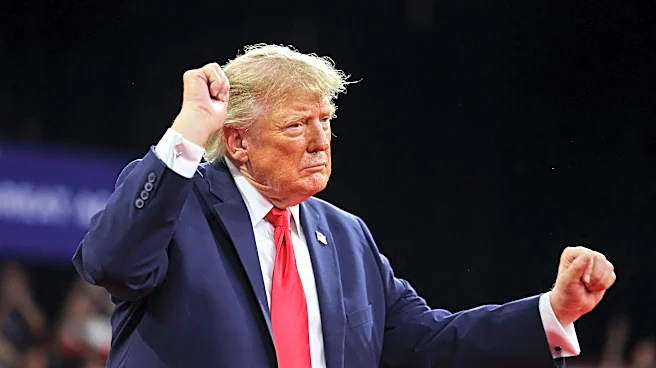
A new CNBC report indicates a shift in terminology among some prominent tech leaders, who are now rebranding 'AI' as 'superintelligence.' This change follows a directive from President Trump, roughly a month prior, for federal agencies to adopt the term 'superintelligence'
instead of 'artificial intelligence.' Notably, Meta's Mark Zuckerberg and Tesla and SpaceX's Elon Musk have begun using 'superintelligence' in their third-quarter earnings calls. However, other major tech CEOs, including those from Microsoft, Amazon, and Alphabet, have continued to use 'AI.' The term 'superintelligence' generally refers to AI that significantly surpasses human intellectual capabilities across a broad range of activities, a claim that warrants scrutiny due to its ambitious nature.
Why It's Important?
The rebranding of AI as 'superintelligence' by some tech leaders, influenced by a White House directive, carries significant implications for public perception and policy. The term 'superintelligence' suggests a level of AI capability that is far beyond current achievements, potentially creating unrealistic expectations among consumers and policymakers. This linguistic shift could influence how the public trusts and interacts with AI technologies, as the label 'super' might imply infallibility or superior judgment, potentially leading users to rely on AI without sufficient critical evaluation. For businesses, adopting this term could be a marketing strategy, but it also places a higher burden of proof on companies to demonstrate such advanced capabilities. The divergence in terminology among tech giants also highlights a potential split in how the industry views and communicates about the future of AI, impacting investment, research priorities, and regulatory discussions.
What's Next?
The continued use of 'superintelligence' by some tech leaders, particularly after a directive from the White House, suggests a potential push to redefine the public and governmental understanding of AI's capabilities. This could lead to increased scrutiny from media and experts, who will likely demand clearer evidence and definitions for such a grand claim. Policymakers may also be influenced by this terminology, potentially shaping future regulations, funding for AI research, and national strategies for technological development. The differing approaches among tech CEOs could also lead to a fragmented public discourse on AI, making it more challenging to establish common standards or ethical guidelines. Companies using the term 'superintelligence' will face pressure to articulate how they define and measure this advanced form of AI, and how it translates into tangible products and services.
Beyond the Headlines
The debate over terminology, particularly the shift from 'AI' to 'superintelligence,' delves into deeper philosophical and ethical considerations about the nature of intelligence and humanity's relationship with advanced technology. The term 'superintelligence' evokes a sense of an entity that could potentially operate beyond human control or comprehension, raising concerns about existential risks and the future of human agency. This linguistic shift, especially when driven by political directives, can subtly influence public imagination and policy decisions, potentially accelerating or misdirecting efforts in AI development. It also highlights the power of language in shaping technological narratives and public expectations, underscoring the responsibility of leaders in both government and industry to use precise and accurate terminology when discussing transformative technologies. The long-term impact could be a re-evaluation of what constitutes 'intelligence' in machines and a more intense focus on the societal implications of truly advanced AI.