



What's Happening?
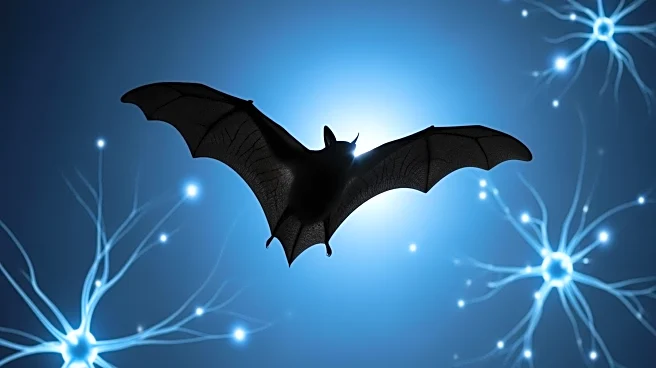
Researchers have conducted a study on a remote island in the Indian Ocean to understand how bats develop a sense of direction. The study, published in Science, involved monitoring bats with brain implants to track their navigation. The findings revealed
that bats use a network of brain cells to form a mental map of their environment, relying on landmarks rather than the Earth's magnetic field or stars. This research supports existing theories about the mammalian brain's internal compass, known as 'head direction cells,' which may also exist in humans. The study emphasizes the importance of conducting experiments in natural settings to gain insights into brain function.
Why It's Important?
This study is significant as it confirms decades of laboratory research on how mammals navigate their environment. Understanding the brain's internal compass can provide insights into human navigation and spatial awareness. The research highlights the potential for natural experiments to reveal more about brain function than controlled lab settings. This could lead to advancements in neuroscience, particularly in understanding how the brain processes spatial information, which is crucial for developing treatments for neurological disorders affecting navigation and memory.
What's Next?
Future research may focus on identifying similar internal compass mechanisms in humans, which could explain common experiences like disorientation and reorientation. This could have implications for understanding and treating conditions that affect spatial awareness and memory. Additionally, the study encourages more naturalistic experiments in neuroscience, which could lead to new discoveries about brain function and its applications in medicine and technology.