



What's Happening?
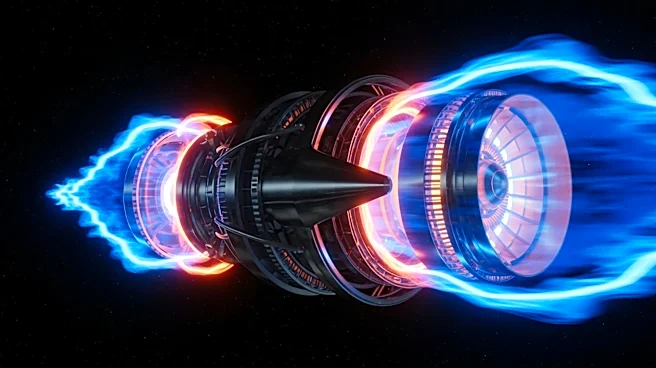
NASA's Jet Propulsion Laboratory (JPL) has made significant advancements in electric thruster technology, which could be pivotal in enabling human travel to Mars. The new development involves a magnetoplasmadynamic (MPD) thruster that operates at up to 120
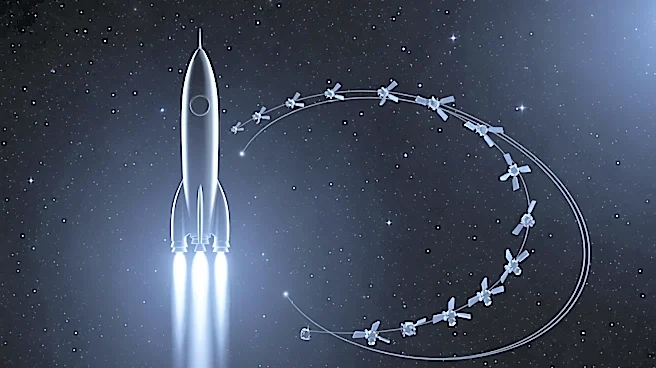
kW of power, significantly more than the current electric thrusters used in space missions. Unlike traditional chemical rockets, which require large amounts of fuel, these electric thrusters use electrical energy to ionize inert gases, creating propulsion with much less fuel. This makes spacecraft lighter and more efficient for long-distance space travel. The MPD thruster uses nuclear power to accelerate lithium plasma, and NASA aims to increase its power output to between 500 kW and one megawatt per thruster. This technology is seen as a potential game-changer for deep space missions, including the ambitious goal of sending humans to Mars.
Why It's Important?
The development of more efficient propulsion systems is crucial for the future of space exploration, particularly for missions beyond Earth's orbit. Traditional chemical rockets are not ideal for long-distance travel due to their heavy fuel requirements and inefficiency. NASA's new MPD thruster technology could significantly reduce the amount of fuel needed, allowing for lighter spacecraft and potentially longer missions. This advancement not only supports NASA's goal of sending humans to Mars but also enhances the feasibility of establishing a sustainable human presence on the Moon and other celestial bodies. The ability to travel further and faster in space could open new opportunities for scientific research, resource exploration, and even commercial ventures in space.
What's Next?
NASA plans to continue testing and refining the MPD thruster technology, with the goal of achieving the power levels necessary for a manned mission to Mars. The agency is focused on overcoming challenges related to heat management and durability, as the thrusters need to operate under extreme conditions for extended periods. If successful, this technology could be integrated into future missions, potentially revolutionizing how humans explore space. Additionally, NASA's ongoing efforts to build a Moon base could serve as a testing ground for these new propulsion systems, providing valuable insights and experience for future Mars missions.