






What's Happening?
During President Trump's first term, North Korea significantly advanced its nuclear and ballistic missile programs despite diplomatic efforts. By 2017, North Korea was estimated to possess enough fissile material for 60 weapons and was rapidly developing
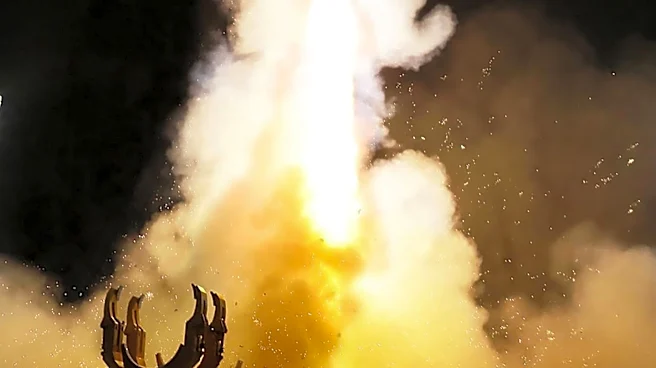
its ballistic missile capabilities. While President Trump engaged in personal diplomacy with North Korean leader Kim Jong Un, including exchanging 'beautiful letters,' North Korea continued to enrich plutonium and develop short-range missiles. In October 2020, North Korea unveiled a massive intercontinental ballistic missile (ICBM) designed to carry multiple warheads, theoretically capable of overwhelming U.S. defenses. This development occurred even as President Trump publicly pursued a strategy of personal engagement with Kim Jong Un, which some critics argue granted international prestige to the North Korean leader without securing tangible denuclearization commitments.
Why It's Important?
The acceleration of North Korea's nuclear and missile programs under President Trump's watch has significant implications for U.S. national security and global stability. The development of ICBMs capable of reaching the U.S. mainland represents a direct threat, challenging existing defense strategies and potentially escalating regional tensions. The perceived failure of personal diplomacy to halt or reverse North Korea's nuclear ambitions could influence future U.S. foreign policy approaches to rogue states. Furthermore, the source suggests that President Trump's contrasting approaches to North Korea (deference) and Iran (antagonism) may have inadvertently sent a message to other nations that acquiring nuclear weapons is a path to gaining respect from the United States. This could potentially fuel a broader global nuclear arms race, undermining non-proliferation efforts and increasing the risk of nuclear conflict.
What's Next?
The current strategic partnership between North Korea and Russia, involving North Korea supplying arms and soldiers to Russia in exchange for food aid and advanced technology, indicates a deepening alliance that could further bolster North Korea's military capabilities. This cooperation poses a challenge to Western nations and could lead to increased efforts by the U.S. and its allies to counter this axis. The continued development of North Korea's missile technology, potentially aided by Russian expertise, suggests that future missile tests and advancements are likely. The U.S. will need to reassess its strategy for dealing with a nuclear-armed North Korea that is increasingly integrated into a broader anti-Western alliance, potentially leading to new sanctions, diplomatic pressures, or military posturing in the region.
Beyond the Headlines
The narrative surrounding President Trump's handling of North Korea raises deeper questions about the effectiveness of personalized diplomacy versus traditional multilateral approaches in addressing complex geopolitical challenges. The idea that a leader's personal rapport could supersede established diplomatic frameworks and intelligence assessments is a recurring theme. The source also draws a parallel to the 'who lost China' debate of the 1950s, suggesting that future historians might debate who 'started the global nuclear arms race' in this era, with President Trump's name potentially featuring prominently. This highlights the long-term historical and ethical implications of foreign policy decisions, particularly concerning nuclear proliferation, and how they can shape global power dynamics and security paradigms for decades to come.