



What's Happening?
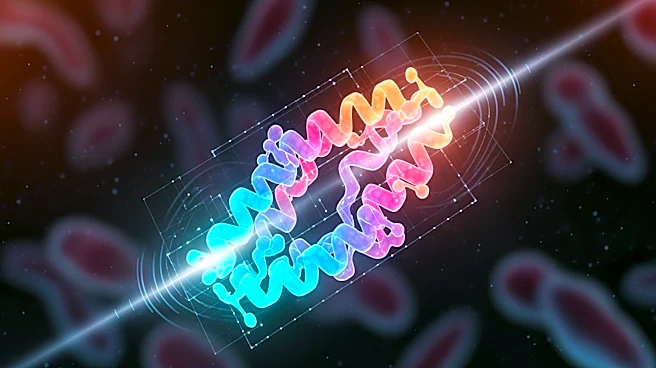
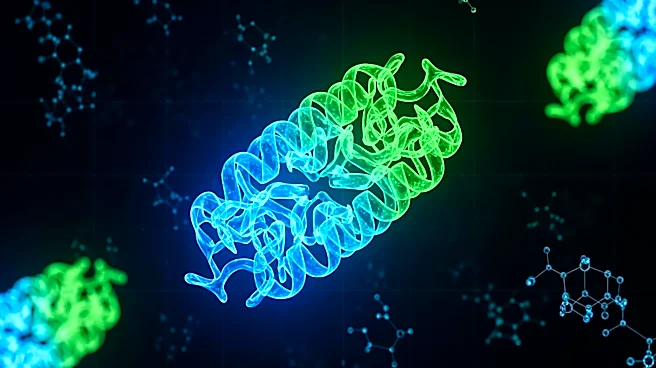
A team led by HHMI Investigator David Baker and Janelia Senior Group Leader Luke Lavis is utilizing artificial intelligence to develop a new class of fluorescent imaging probes called NovoTags. These probes are designed by creating novel, small proteins
that bind to fluorescent dyes, allowing for enhanced detection of proteins and structures within cells. This initiative is part of AI@HHMI, a $500 million project aimed at integrating AI into scientific research. The AI model developed by the Baker Lab enables the creation of proteins that bind specifically to Janelia Fluor dyes, facilitating experiments that were previously not possible with existing probes. This advancement is expected to significantly accelerate scientific discovery by allowing researchers to visualize multiple proteins simultaneously over extended periods.
Why It's Important?
The development of NovoTags represents a significant leap forward in biological imaging, offering researchers the ability to conduct more complex and detailed studies of cellular processes. This technology could lead to breakthroughs in understanding cellular interactions and functions, potentially impacting fields such as drug discovery and disease research. By enabling the visualization of multiple proteins at once, scientists can gain a more comprehensive understanding of cellular mechanisms, which is crucial for developing targeted therapies and advancing biomedical research.
What's Next?
The team plans to expand the NovoTag technology to include a wider range of fluorescent dyes, allowing for even more detailed imaging capabilities. They also aim to develop probes that can measure specific physiological signals, such as calcium levels or metabolic activity. These advancements will be made available to the scientific community, potentially transforming research methodologies and accelerating the pace of discovery in various biological fields.