





What's Happening?
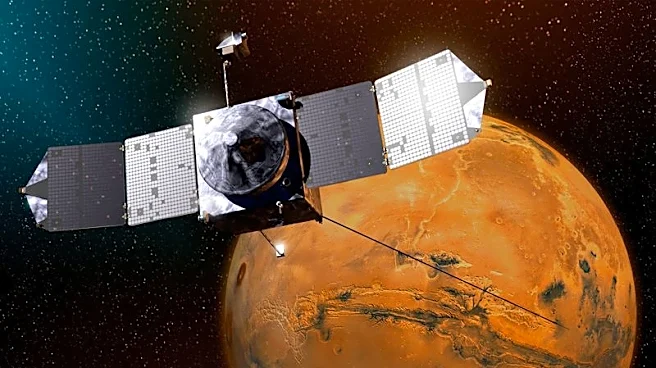
NASA has officially declared the MAVEN spacecraft, a key asset in Mars exploration, as unrecoverable after losing contact with it six months ago. The spacecraft, which was launched in November 2013, was designed to study the Martian atmosphere and its
evolution. It exceeded its expected one-year mission, operating for over 11 years. The last communication from MAVEN was received on December 6, 2025, before it went behind Mars and failed to reestablish contact. The spacecraft entered a high-speed spin, which drained its batteries and led to a loss of power in its communication system. Despite efforts to regain contact, including attempts to reboot its onboard computer, the spacecraft remains silent. An investigation into the cause of the malfunction is ongoing, with a final report expected later this year.
Why It's Important?
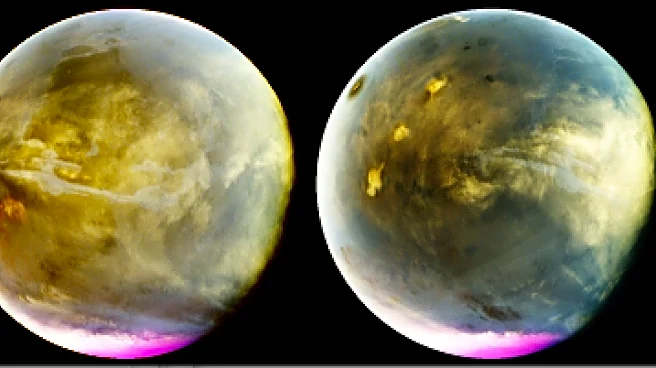
The MAVEN mission has significantly advanced scientific understanding of Mars' atmosphere, providing crucial data on how solar winds have stripped the planet of its air and water. This information is vital for future human exploration of Mars, as it informs necessary radiation protection and safety measures. MAVEN also served as a communication relay for surface rovers, and its loss complicates data transmission for ongoing and future missions. However, other NASA and European Space Agency orbiters are expected to fill this gap, albeit with some delays. The mission's findings will continue to influence Mars research and exploration strategies for years to come.
What's Next?
NASA and its partners will rely on other orbiters, such as the Mars Odyssey and Mars Reconnaissance Orbiter, to continue communication with Mars rovers and collect scientific data. The agency is also preparing for the ESCAPADE mission, which will study the Martian atmosphere further. The MAVEN spacecraft is expected to remain in orbit for another 50 to 100 years before its orbit decays, eventually burning up in Mars' atmosphere. The data collected by MAVEN will continue to be analyzed, providing insights into Mars' past and aiding in the planning of future missions.