



What's Happening?
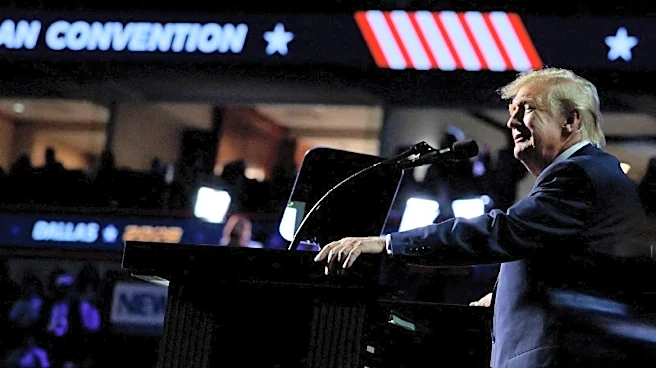
During a campaign rally in Dallas on September 9, President Trump reiterated his intention to impose substantial tariffs on semiconductor chips manufactured in Taiwan. He suggested potential tariff rates of 50%, 100%, or 200%. Concurrently, President Trump also
proposed an election-year dividend of $5,000 for every adult U.S. citizen, contingent on Republicans securing control of both chambers of Congress in the upcoming November midterms. This proposed dividend, estimated to cost $1.35 trillion across the approximately 270 million adult U.S. population, would require recipients to spend the funds domestically. In response, Taiwan’s Executive Yuan stated that a January memorandum of understanding (MOU) securing Section 232 semiconductor tariff relief remains in effect, indicating ongoing discussions regarding specific semiconductor exemptions.
Why It's Important?
President Trump's renewed threat of tariffs on Taiwan-made chips introduces significant regulatory uncertainty for the U.S. semiconductor industry and its supply chain. Taiwan is a critical global hub for advanced chip manufacturing, and tariffs could lead to increased costs for U.S. technology companies that rely on these components, potentially impacting consumer prices for electronic goods. The proposed $5,000 dividend, if implemented, could inject a substantial amount of money into the U.S. economy, potentially stimulating consumer spending. However, the requirement for domestic spending and the sheer scale of the payout raise questions about its feasibility and potential inflationary effects. The contrasting positions between President Trump's campaign rhetoric and Taiwan's assertion of an existing MOU highlight the complex interplay of trade policy, geopolitical strategy, and domestic political considerations.
What's Next?
The immediate future will likely involve continued monitoring of President Trump's campaign rhetoric regarding trade policies and the reactions from the semiconductor industry and international trade partners. Taiwan's Executive Yuan will likely continue to emphasize the existing MOU and engage in discussions to secure specific semiconductor tariff relief. The outcome of the November midterm elections will be crucial in determining the political landscape that could enable or hinder the implementation of President Trump's proposed dividend and tariff policies. Businesses in the U.S. and Taiwan will need to assess the potential risks and opportunities associated with these policy proposals, particularly concerning supply chain adjustments and market strategies.
Beyond the Headlines
Beyond the immediate economic and political implications, President Trump's statements underscore a broader trend of using trade policy as a tool for both economic leverage and domestic political appeal. The focus on tariffs on critical components like semiconductors highlights the increasing recognition of their strategic importance in national security and technological competitiveness. The proposed dividend also touches upon the ongoing debate about government intervention in the economy and wealth redistribution, particularly in an election year. This situation could further strain U.S.-Taiwan trade relations, even as the U.S. seeks to bolster its domestic chip manufacturing capabilities. The emphasis on domestic spending for the dividend also reflects a protectionist sentiment aimed at boosting the U.S. economy directly.