

What's Happening?
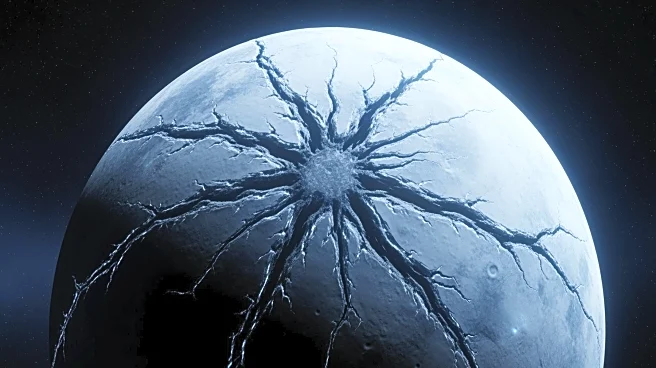
A team of planetary scientists has identified a spider-like feature on the surface of Europa, one of Jupiter's moons, which may provide insights into subsurface activity. Named 'Damhán Alla,' this feature resembles an arachnid or an exploded asterisk
and was first observed by NASA's Galileo mission. The study, published in The Planetary Science Journal, suggests that these formations could be caused by water erupting through Europa's icy shell. The research, led by Lauren Mc Keown from the University of Central Florida, indicates that such surface features could reveal the presence of brine pools beneath the ice. Europa is considered a promising candidate for off-world life due to its suspected subsurface saltwater ocean.
Why It's Important?
The discovery of the spider-like feature on Europa is significant as it could enhance our understanding of the moon's potential to support life. The presence of subsurface water is a critical factor in the search for extraterrestrial life, and these formations might indicate active geological processes. If further observations by NASA's Europa Clipper mission confirm the existence of brine pools, it could lead to a better understanding of Europa's habitability. This research also contributes to the broader field of planetary science by providing a model for studying similar features on other icy bodies in the solar system.
What's Next?
NASA's Europa Clipper mission, currently en route to Jupiter, is expected to provide more detailed observations of Europa's surface and subsurface. The mission aims to map the moon's ice shell and investigate its composition, which could confirm the presence of subsurface water. The findings from this mission could influence future exploratory missions and the search for life beyond Earth. Scientists will continue to analyze data from Europa Clipper to understand the moon's geological activity and its implications for astrobiology.