





What's Happening?
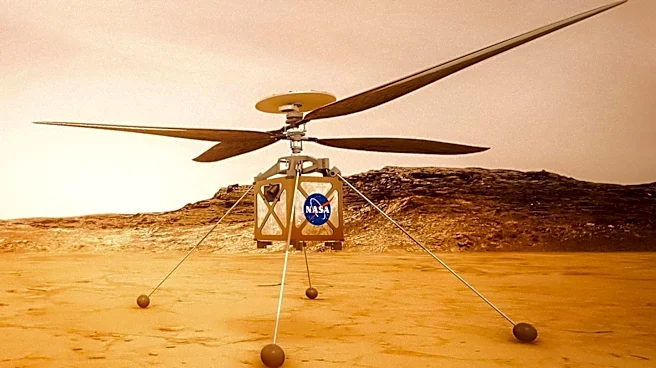
NASA researchers are developing new rotorcraft blades designed to significantly enhance the flight capabilities of future Mars helicopters. Building on the success of the Ingenuity helicopter, which made the first powered flight on another planet, engineers
are utilizing high-fidelity computer simulations and wind tunnel tests to reimagine blade designs. The goal is to enable future Mars flyers to achieve greater altitudes and distances while carrying scientific instruments. A team at NASA’s Ames Research Center, in collaboration with Imperial College London and Nagoya University, has developed a new airfoil called roamx-0201. This optimized design, specifically tuned for Mars' thin atmosphere, has shown improved aerodynamic performance and better recovery in challenging flight conditions during wind-tunnel tests. The findings, published in the journal of the American Institute of Aeronautics and Astronautics, indicate that these redesigned blades could extend a single flight's range from Ingenuity's 0.7 kilometers to up to 18.7 kilometers, even with scientific payloads.
Why It's Important?
This development is crucial for advancing planetary exploration and scientific discovery on Mars. The ability to fly farther and higher with increased payload capacity will allow future missions to access and study more diverse and remote Martian terrains, potentially uncovering new geological features, signs of past water, or even biosignatures. Enhanced flight range and stability reduce the risks associated with ground-based rovers in difficult environments and expand the scope of aerial reconnaissance. This technological leap could lead to more comprehensive data collection, improving our understanding of Mars' geology, atmosphere, and potential for life. The collaboration between international research institutions also highlights the global effort in space exploration and the shared scientific goals of understanding our solar system.
What's Next?
The next steps involve further refinement and testing of the roamx-0201 airfoil and its integration into future Mars helicopter designs. The SkyFall mission, scheduled for launch in 2028, will feature a trio of helicopters building on Ingenuity's legacy, and subsequent missions are expected to incorporate these advanced blade technologies. Researchers will continue to conduct simulations and physical tests to ensure the blades' durability and performance under the extreme conditions of the Martian environment. The focus will also be on optimizing the integration of scientific instruments with these enhanced flight systems, ensuring that the increased range translates into meaningful scientific returns. Successful implementation could pave the way for more ambitious aerial exploration missions on Mars and potentially other celestial bodies with thin atmospheres.
Beyond the Headlines
The development of these advanced rotorcraft blades represents a broader trend in space exploration towards more agile and versatile robotic explorers. Beyond the immediate benefits for Mars missions, the methodologies and materials science advancements could have implications for aeronautical engineering on Earth, particularly in high-altitude flight or drone technology. The ability to design and test airfoils for extremely thin atmospheres pushes the boundaries of aerodynamic principles. This research also underscores the increasing reliance on sophisticated computational modeling and simulation in engineering, allowing for rapid iteration and optimization of designs before physical prototyping. Such innovations could ultimately lead to more efficient and resilient aerial vehicles for both extraterrestrial and terrestrial applications, fostering a new era of aerial mobility and exploration.