




What's Happening?
Oak Ridge National Laboratory (ORNL) and Idaho National Laboratory (INL) are collaborating to advance the use of large-scale metal 3D printing, specifically wire arc additive manufacturing, for producing industrial pressure vessels critical to nuclear
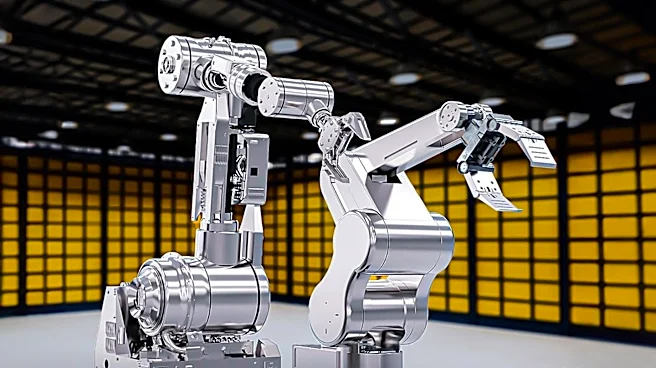
reactors. This initiative aims to overcome manufacturing bottlenecks and enhance the domestic production capabilities for advanced nuclear designs. Recently, ORNL demonstrated this technology by 3D printing a nuclear-relevant pressure vessel, approximately three feet by five feet, using a system called MedUSA, which coordinates three robotic arms. This system melts steel wire with electric arcs to build complex metal structures. The successful production of a large, enclosed vessel from a steel alloy relevant to nuclear applications marks a significant step towards using additive manufacturing for components traditionally made through forging. The collaboration focuses on combining large-scale additive manufacturing with digital engineering and real-time monitoring to ensure components meet stringent nuclear requirements and shorten qualification timelines.
Why It's Important?
This development is crucial for the United States' nuclear energy ambitions, as it addresses a significant challenge in the domestic manufacturing base for new reactor designs. The current limitations in forging capacity could create supply chain issues for new nuclear projects. By expanding manufacturing options through advanced 3D printing, the U.S. can accelerate the deployment of advanced reactors and reduce reliance on external suppliers. This technology also has broader implications beyond nuclear energy, potentially supporting sectors like aerospace, defense, chemical processing, and oil and gas, all of which require structures designed for demanding environments. The ability to reliably print and qualify pressure vessels could provide an alternative route around limited forging capacity, fostering a more robust and resilient domestic manufacturing ecosystem. Furthermore, the integration of real-time monitoring and digital engineering aims to create 'born-qualified' components, streamlining the certification process and speeding up deployment.
What's Next?
The immediate next steps involve ORNL and INL continuing to evaluate whether the additive manufacturing process can produce components that meet the demanding requirements for nuclear applications. This includes verifying that each component can withstand years of operation in extreme environments. Researchers will focus on tracking a component's shape and material properties during production to gather data for performance evaluation, potentially reducing the need for extensive post-manufacturing testing. The long-term goal is to establish a robust method for producing 'born-qualified' pressure vessels, which would significantly shorten qualification timelines and accelerate the deployment of nuclear hardware. This collaboration is expected to expand U.S. options for producing large, high-integrity metal components, paving the way for more efficient and localized manufacturing of critical infrastructure for the energy sector and beyond.
Beyond the Headlines
The shift towards additive manufacturing for critical components like nuclear pressure vessels represents a broader trend in industrial production, emphasizing customization, efficiency, and supply chain resilience. This approach could fundamentally alter how complex, high-value parts are designed, produced, and certified, moving away from traditional, often time-consuming and resource-intensive methods. Ethically, ensuring the integrity and safety of 3D-printed nuclear components is paramount, requiring rigorous testing and validation protocols. Legally, this innovation may necessitate updates to regulatory frameworks to accommodate new manufacturing processes and materials. Culturally, it signifies a move towards greater technological self-reliance and innovation in critical infrastructure sectors, potentially fostering a new generation of skilled workers in advanced manufacturing and digital engineering. The long-term impact could be a more agile and responsive industrial base, capable of adapting to evolving technological demands and geopolitical shifts.