







What's Happening?
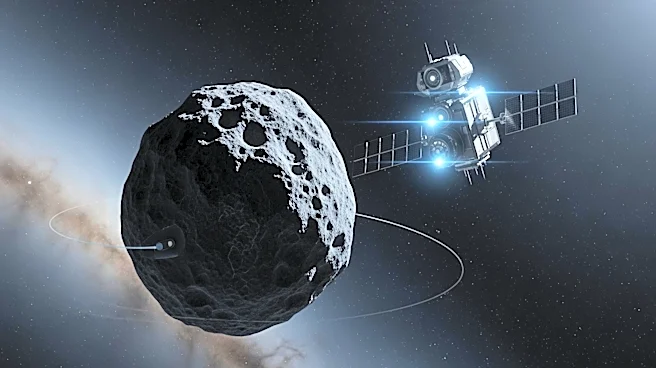
NASA has confirmed that the asteroid Apophis, named after the ancient Egyptian God of evil and destruction, will pass remarkably close to Earth on April 13, 2029. This event is significant as Apophis will come within 20,000 miles of Earth, closer than
many satellites orbiting the planet. Initially discovered in 2004, Apophis was once thought to have a potential impact risk in 2029, 2036, or 2068. However, continuous monitoring and updated radar observations have ruled out any collision risk for at least the next 100 years. The asteroid, which spans approximately 1,230 feet, will be visible to the naked eye, providing a rare opportunity for scientists to study it closely.
Why It's Important?
The close approach of Apophis presents a unique opportunity for scientific study, as such events are extraordinarily rare. This flyby will allow researchers to observe the asteroid's characteristics and behavior in detail, potentially offering insights into the composition and dynamics of similar celestial bodies. Understanding asteroids is crucial for planetary defense strategies and could inform future missions aimed at mitigating potential asteroid threats. Additionally, the event underscores the importance of continued investment in space observation technologies to monitor near-Earth objects that could pose a threat to the planet.
What's Next?
As the 2029 flyby approaches, NASA and other space agencies are likely to prepare for extensive observation campaigns to maximize the scientific return from this event. This could involve deploying telescopes and radar systems to track Apophis' trajectory and study its physical properties. The data collected may contribute to refining models of asteroid dynamics and inform future missions aimed at asteroid deflection or resource utilization. Public interest in the event may also increase, leading to educational initiatives to raise awareness about asteroid science and planetary defense.