
What's Happening?
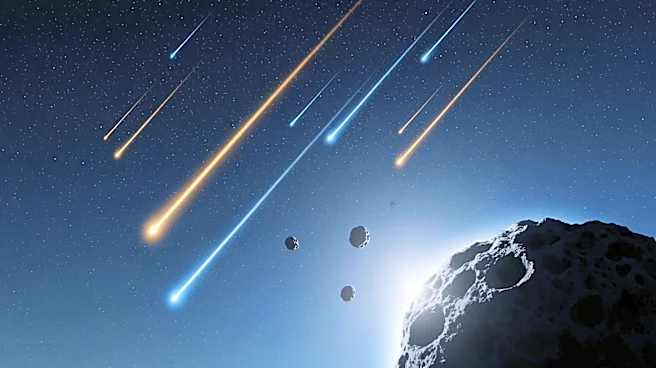
A new meteor shower has been discovered, originating from an asteroid that is being broken down by the Sun. This finding was made by astronomers who used camera observations from all-sky networks in Canada,
Japan, California, and Europe. The meteor shower is linked to an asteroid that ventured too close to the Sun, causing it to release dust and fragments. This discovery adds to the understanding of how asteroids and comets behave when subjected to solar heat. The study, published in March 2026, identified a cluster of 282 meteors, indicating the presence of a previously hidden asteroid. The meteor shower's parent asteroid remains unidentified, but future missions like NASA's NEO Surveyor, set to launch in 2027, may help locate it.
Why It's Important?
The discovery of this meteor shower is significant as it provides insights into the behavior of asteroids under solar influence. Understanding these processes is crucial for planetary defense, as it helps identify potentially hazardous near-Earth objects. The ability to detect meteor showers can also reveal hidden asteroids that are not visible through traditional telescopes. This research contributes to the broader knowledge of the solar system's dynamics and the evolution of celestial bodies. It highlights the importance of continuous monitoring and study of space debris, which can have implications for both scientific exploration and the safety of Earth.
What's Next?
The next steps involve further analysis of the meteor shower to understand its composition and origin. NASA's upcoming NEO Surveyor mission will play a key role in identifying the parent asteroid and assessing its potential threat to Earth. This mission is part of a broader effort to enhance planetary defense capabilities by discovering and tracking near-Earth objects. Additionally, ongoing research will focus on the physical changes asteroids undergo when exposed to solar heat, which could inform future space missions and exploration strategies.