







What's Happening?
Corridian, a New England-based defense technology startup, has successfully raised $38 million in seed funding. The investment round was led by Point72 Ventures, the global venture capital arm affiliated with Steven A. Cohen's asset management firm, Point72.
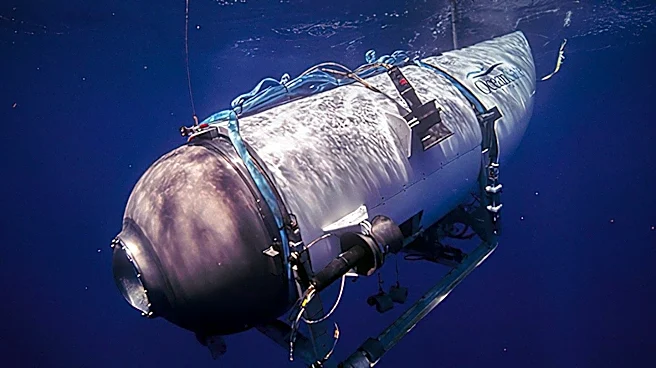
Additional participants in the funding round include Balerion Space Ventures, Harpoon Ventures, DCVC, Marlinspike, and a syndicate of other defense and deep-tech investors. Corridian, founded in 2025 by former General Dynamics executives Mike Guay, Greg Barrow, Kyle Arace, and Mark Bodnar, specializes in developing ultra-large autonomous underwater vehicles (AUVs). These AUVs are designed for military applications, specifically to transport military payloads across contested waters. The company's platforms aim to carry ISO-standard, containerized payloads thousands of nautical miles autonomously, supporting military logistics, intelligence, surveillance, and reconnaissance (ISR), and contested logistics. Corridian emphasizes that its supply chain operates independently of the traditional submarine industrial base.
Why It's Important?
This significant investment in Corridian highlights a growing focus on advanced autonomous defense technologies within the U.S. and its allies. The development of ultra-large AUVs capable of long-range, uncrewed payload transport addresses critical strategic needs, particularly in contested environments where traditional manned operations might be too risky or inefficient. For the U.S. military and its partners, these AUVs could enhance logistical capabilities, improve intelligence gathering, and provide new options for delivering effects without putting personnel in harm's way. The independence of Corridian's supply chain from the existing submarine industrial base is also noteworthy, suggesting a potential for faster innovation and deployment cycles, and possibly reducing reliance on established, often slower, defense procurement channels. This could lead to a more agile and resilient defense infrastructure, impacting national security strategies and defense spending priorities.
What's Next?
Corridian will likely utilize the $38 million in seed funding to accelerate the development and testing of its ultra-large autonomous underwater vehicles. The company's immediate focus will be on refining its platforms to ensure they can effectively transport ISO-standard, containerized payloads over thousands of nautical miles. Further collaboration with the U.S. Navy, Royal Australian Navy, and other mission partners, with whom the founders have prior experience, is anticipated as Corridian moves towards operational deployment. The success of these AUVs could lead to increased adoption by defense forces, potentially influencing future military procurement strategies and investment in autonomous systems. The involvement of Point72 Ventures suggests a long-term vision for Corridian's growth, possibly leading to further funding rounds or strategic partnerships as the technology matures and demonstrates its capabilities.
Beyond the Headlines
The emergence of companies like Corridian signifies a broader shift in defense strategy towards unmanned and autonomous systems, reflecting advancements in artificial intelligence and robotics. This trend raises important ethical and legal considerations regarding the deployment and control of autonomous weapons systems, as well as the implications for international maritime law and naval warfare. The ability to transport military payloads autonomously across vast distances could redefine concepts of power projection and logistical support, potentially altering geopolitical dynamics. Furthermore, the focus on an independent supply chain could foster a new ecosystem of defense technology providers, challenging the dominance of traditional defense contractors and encouraging more rapid technological evolution in the sector. This development could also spur innovation in related fields, such as advanced materials, energy storage for long-duration underwater operations, and secure communication systems.