





What's Happening?
A meteorite, designated Teghaza 001, discovered in the Sahara Desert in 2022, has been identified as originating from the Martian crust at least 4.1 billion years ago. This makes it potentially the oldest of the 435 known Martian meteorites found on Earth.
A new study indicates that the meteorite's composition provides significant insights into the early conditions on Mars, suggesting the presence of liquid water and strengthening the theory that ancient Mars could have supported microbial life. Planetary scientist Yang Liu of NASA's Jet Propulsion Laboratory (JPL) described the meteorite as a 'witness to a time when Mars was likely warmer and wetter than it has been for most of its history.' The chemical makeup of the gabbro rock, including oxygen and hydrogen isotopes, suggests water seeped deep into the Martian crust and mixed with molten rock.
Why It's Important?
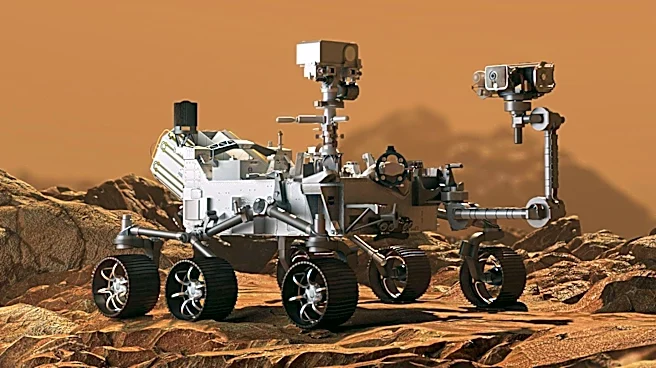
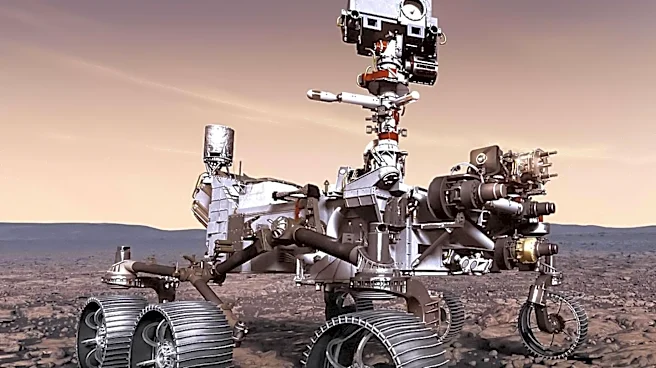
This discovery is crucial for U.S. planetary science and NASA's ongoing efforts to understand the potential for life beyond Earth. The evidence of liquid water on Mars over 4.1 billion years ago, a period when life was beginning on Earth, provides a critical comparative timeline for astrobiological research. For NASA, which manages JPL and Ames Research Center, these findings validate and complement data gathered by its Mars rovers and orbiters, offering tangible samples for laboratory analysis that cannot be replicated in situ. The study helps refine models of early planetary evolution and the conditions necessary for habitability, directly influencing future mission planning and scientific objectives for Mars exploration. It underscores the importance of meteorite analysis in piecing together the Red Planet's ancient history and its divergence from Earth's evolutionary path.
What's Next?
While the Teghaza 001 meteorite provides strong evidence for the necessary ingredients and conditions for life on early Mars, it does not definitively answer whether life actually existed. Future research will likely focus on further detailed analysis of this and other ancient Martian meteorites to search for biosignatures or more direct evidence of past microbial activity. The findings will also inform the design and objectives of upcoming NASA missions to Mars, guiding the selection of landing sites and the types of instruments used to detect signs of ancient life. Scientists will continue to compare the evolutionary paths of Mars and Earth, seeking to understand why Mars transitioned from a potentially habitable world to its current cold, dry state. This ongoing research will contribute to a broader understanding of planetary habitability within our solar system and beyond.
Beyond the Headlines
The study of Teghaza 001 touches upon profound philosophical and scientific questions regarding the uniqueness of life in the universe. If Mars, a neighboring planet, once harbored conditions suitable for life, it increases the probability of life existing elsewhere. This has implications for the search for exoplanets and the criteria used to identify potentially habitable worlds. Furthermore, the meteorite's journey from Mars to Earth, and its subsequent discovery, highlights the serendipitous nature of scientific breakthroughs and the value of preserving such extraterrestrial samples. The collaboration between institutions like NASA's JPL and Ames Research Center, and the BAER Institute, exemplifies the interdisciplinary effort required to unravel the mysteries of our solar system, pushing the boundaries of human knowledge and inspiring future generations of scientists and explorers.