


What's Happening?
A 2025 model indicates that the magnetic field generated by the convective currents within Europa's vast subsurface saltwater ocean would be weaker than one nanotesla. This finding suggests that the magnetic signature produced by the moving saltwater is likely
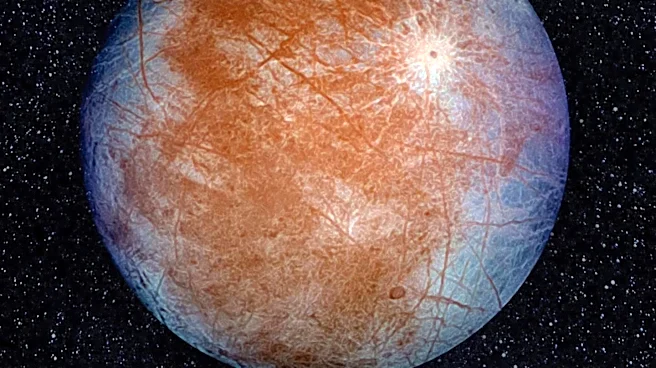
too faint for current missions like NASA's Europa Clipper or ESA's JUICE to isolate from the significant magnetic noise surrounding Jupiter. Europa, a moon slightly smaller than Earth's Moon, is believed to harbor more than twice the liquid water of all Earth's oceans combined, with models suggesting active convection, eddies, and broad circulation cells beneath its icy shell. While Galileo's previous magnetic evidence for Europa's ocean remains valid, this new study focuses on the much smaller signal generated by the physical movement of the ocean water itself, rather than the larger, periodic induction response to Jupiter's changing magnetic field.
Why It's Important?
This research is significant because it refines our understanding of the detectability of internal processes on Europa, a prime candidate for extraterrestrial life. The inability to directly measure the magnetic field generated by ocean currents limits a potential method for mapping the movement of Europa's ocean from above the ice. While it does not negate the existence of the ocean or its dynamic nature, it means scientists will need to rely more heavily on other instruments and data, such as radar, gravity measurements, and topography, to characterize the ocean's properties and circulation. This adjustment in expectations impacts the scientific strategies for upcoming missions, emphasizing the challenges of remote sensing in complex astrophysical environments and the need for multi-instrument approaches to unravel planetary mysteries.
What's Next?
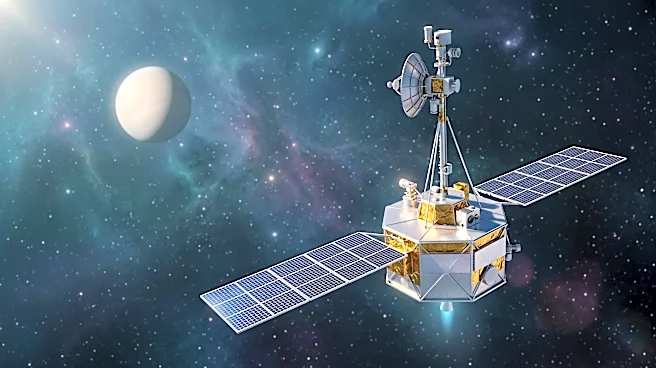
Despite the challenges in detecting the circulation-generated magnetic field, NASA's Europa Clipper, en route to Jupiter, is still slated to begin its Europa campaign in 2030. The mission, along with ESA's JUICE, will proceed with its planned observations using a suite of instruments. These include radar to probe the ice, radio tracking to measure gravity and tidal flexing, cameras for geological mapping, and spectrometers to analyze surface material. While direct magnetic mapping of ocean currents may be difficult, the primary magnetic objective of detecting the regular induction response remains crucial for confirming the ocean's properties. Future research will likely focus on refining models of Europa's ocean dynamics and exploring alternative methods to infer its circulation patterns from other observable phenomena.
Beyond the Headlines
This finding underscores the immense complexity of studying distant celestial bodies and the limitations of current observational technologies. The fact that an ocean potentially twice the volume of Earth's oceans can have internal dynamics that are magnetically almost silent from space highlights the subtle nature of planetary processes. It also prompts a deeper consideration of what constitutes 'detectable' evidence in astrobiology and planetary science. The reliance on indirect measurements and complex modeling to infer conditions on Europa emphasizes the interdisciplinary nature of space exploration, combining physics, geology, and engineering. This research also serves as a reminder that even with advanced missions, some aspects of planetary interiors may remain elusive, pushing the boundaries of scientific inquiry and technological innovation.