



What's Happening?
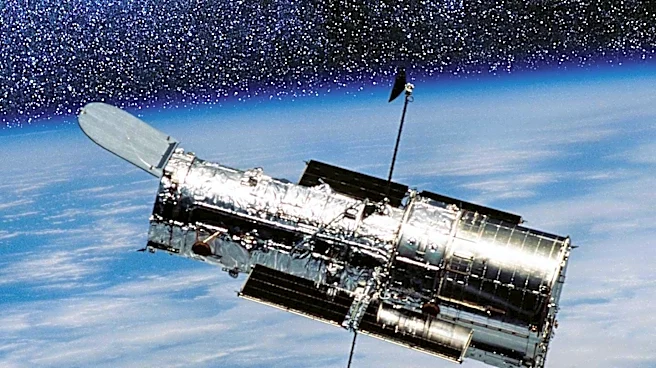
The Hubble Telescope Allocation Committee has released a list of new research programs for 2026, detailing various astronomical studies to be conducted using the Hubble Space Telescope. The programs cover a wide range of topics, including the study of Cepheid
variables, quasar outflows, and the dynamics of globular clusters. Researchers from institutions such as Yale University, the University of Virginia, and the California Institute of Technology are among those leading these initiatives. The allocation of orbits for these programs is designed to maximize the scientific output of the Hubble Space Telescope, with some projects focusing on the study of exoplanets, stellar evolution, and the interstellar medium.
Why It's Important?
The allocation of Hubble Telescope resources to these new research programs is crucial for advancing our understanding of the universe. By supporting a diverse array of studies, the committee ensures that the telescope's capabilities are utilized to address key questions in astrophysics and cosmology. These programs have the potential to provide insights into the formation and evolution of galaxies, the nature of dark matter, and the conditions necessary for planet formation. The findings from these studies could have significant implications for our understanding of the universe and our place within it, influencing future research directions and technological developments in space exploration.