
What's Happening?
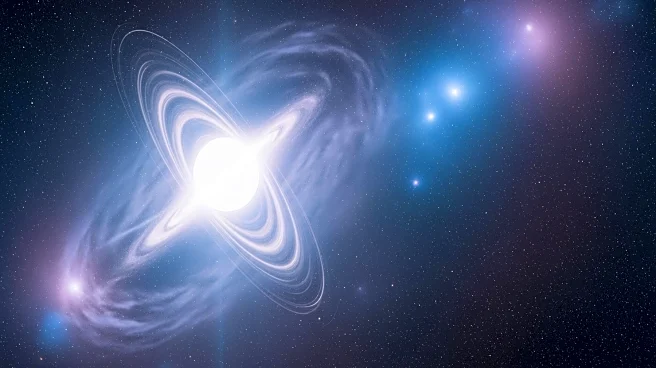
NASA's NEOWISE mission has provided new insights into the transformation of a massive star, M31-2014-DS1, into a black hole in the Andromeda galaxy. Unlike typical supernovae, this star did not explode but instead dimmed significantly, leaving behind
a shroud of gas and dust. The archival data, spanning from 2005 to 2023, revealed that the star brightened in infrared light as it shed its outer layers, eventually collapsing into a black hole. This discovery offers a unique perspective on how black holes can form from stars that fade quietly rather than explode.
Why It's Important?
This finding challenges the traditional understanding of how black holes form, suggesting that some massive stars may transition into black holes without a supernova explosion. This could have significant implications for astrophysics, as it may reveal a common mechanism for black hole formation. Understanding these processes is crucial for comprehending the life cycles of stars and the evolution of galaxies. The research also highlights the value of long-term data collection in uncovering cosmic phenomena.
What's Next?
Researchers will continue to analyze data from NEOWISE and other observatories to identify similar events and refine models of black hole formation. This could lead to new theories about stellar evolution and the conditions necessary for different types of supernovae. The study may also inspire further exploration of the Andromeda galaxy and other regions where such phenomena might occur, potentially leading to new discoveries about the universe's structure and history.