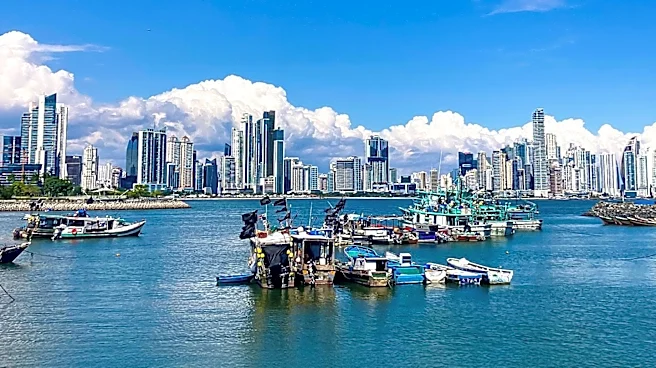



What's Happening?
The United States and Panama are actively collaborating to remove Panama from the U.S. State Department's list of major illicit drug transit or producing countries. U.S. Ambassador to Panama, Kevin Marino Cabrera, stated that Washington is working daily
with the Panamanian government, specifically with President José Raúl Mulino's administration, towards this goal. For five consecutive years, Panama has been the U.S.'s top partner in the region for drug seizures. This ongoing cooperation aims to maintain Panama's leading role in drug interdiction efforts and ultimately lead to its removal from the aforementioned list. The collaboration signifies a continued commitment from both nations to combat drug trafficking and enhance regional security.
Why It's Important?
Panama's inclusion on the U.S. State Department's list of major illicit drug transit or producing countries carries significant implications for its international standing and economic relations. Being on this list can affect foreign investment, international aid, and trade agreements, potentially hindering Panama's economic growth and development. For the U.S., Panama's strategic location as a bridge between North and South America, coupled with the Panama Canal, makes it a critical partner in global efforts to disrupt drug supply chains. Successful removal from the list would not only bolster Panama's reputation but also demonstrate the effectiveness of bilateral cooperation in addressing transnational crime. This partnership is vital for regional stability and the broader fight against illegal narcotics, impacting both U.S. and Panamanian security interests.
What's Next?
The ongoing collaboration between the U.S. and Panama is expected to continue, focusing on enhanced drug interdiction strategies and intelligence sharing. Ambassador Cabrera's remarks indicate a sustained effort to support Panama's role as a key partner in combating drug trafficking. Future steps will likely involve continued training, resource allocation, and policy coordination to strengthen Panama's capacity to intercept illicit drugs. The success of these efforts will be measured by a reduction in drug transit through Panama and, ultimately, its removal from the U.S. State Department's list. This outcome would signify a significant achievement in bilateral relations and regional security, potentially leading to further economic and political benefits for Panama.
Beyond the Headlines
The effort to remove Panama from the U.S. drug transit list extends beyond immediate law enforcement actions, touching upon deeper issues of governance, economic stability, and international trust. Panama's strategic importance, particularly due to the Panama Canal, means that its stability and security have global ramifications for trade and maritime operations. A country's designation on such a list can influence its perceived risk by international financial institutions and businesses, potentially impacting its ability to attract foreign direct investment and participate in global markets. The U.S.'s commitment to helping Panama shed this designation underscores a broader strategy of fostering stable and secure partners in critical geopolitical regions, recognizing that effective counter-narcotics efforts contribute to overall national and international security and economic prosperity.