







What's Happening?
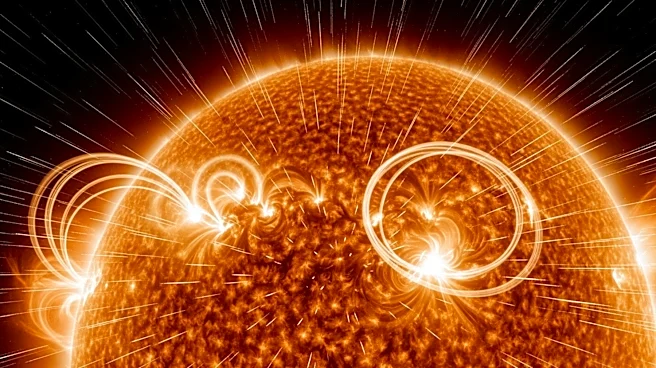
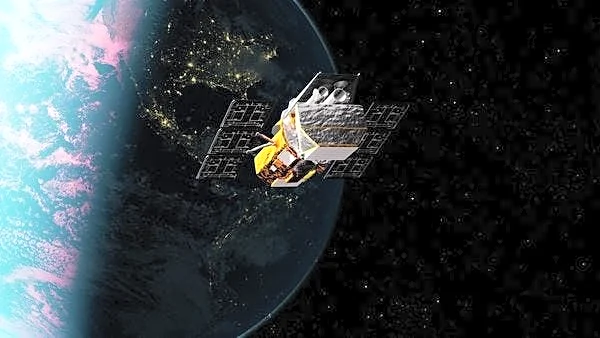
NASA's Parker Solar Probe has made a significant discovery while passing through the solar corona, identifying a source of high-energy particles that existing models had not predicted. During its perihelion encounters, the probe recorded energetic protons
at levels far exceeding what current models of particle acceleration could account for. This discovery was made at the heliospheric current sheet, a region where the Sun's magnetic field reverses polarity. The research, led by Mihir Desai from the Southwest Research Institute and colleagues from the University of Maryland, attributes this unexpected particle acceleration to magnetic reconnection events. These events occur when magnetic field lines break and rejoin, releasing energy into the surrounding plasma. The study, published in The Astrophysical Journal Letters, highlights that the proton energies detected were approximately a thousand times greater than predicted by existing models.
Why It's Important?
The findings from the Parker Solar Probe are crucial as they challenge the current understanding of particle acceleration in the solar corona. The discovery of high-energy particles close to the Sun suggests that magnetic reconnection plays a more significant role in particle acceleration than previously thought. This has implications for understanding solar energetic particles, which can affect spacecraft and astronauts. The research also contributes to the ongoing investigation into why the solar corona is much hotter than the Sun's surface. By identifying magnetic reconnection as a potential energy source, the study provides new insights into the mechanisms that could be heating the corona. This could lead to a revision of existing models and improve predictions of solar activity's impact on space weather.
What's Next?
The Parker Solar Probe will continue its mission, with future perihelion passes expected to provide more data on the heliospheric current sheet. These observations will help determine whether the high-energy particle events are consistent or anomalies. Additionally, the European Space Agency's Solar Orbiter, operating in coordination with Parker, will offer complementary measurements. By comparing data from both missions, scientists aim to better understand the origin and propagation of these energetic particles. This ongoing research will refine models of solar particle acceleration and enhance our understanding of the Sun's influence on the solar system.