



What's Happening?
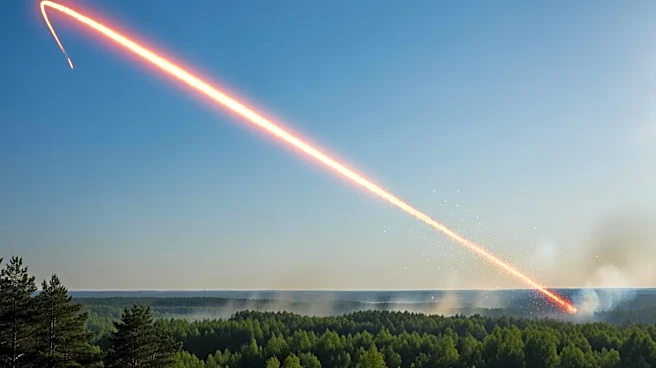
A daylight fireball was observed across multiple northeastern U.S. states on April 7, 2026, at 18:34 UTC. The event generated 260 eyewitness reports and was captured in several videos and photographs. The American Meteor Society (AMS) received reports from
witnesses in Connecticut, Delaware, Maryland, New Jersey, New York, and Pennsylvania. NASA's analysis indicated that the meteor first became visible at an altitude of 76.8 km above the Atlantic Ocean, near Mastic Beach on Long Island, and traveled southwest at approximately 13.5 km/s. The fireball traveled about 188 km through the upper atmosphere before disintegrating at an altitude of 43.9 km above Galloway, New Jersey. Observers noted the meteor's rapid motion, fragmentation, and bright coloration, with some describing it as a 'very bright flare-like object.' This event is part of a series of fireball sightings across the U.S. in recent weeks.
Why It's Important?
The observation of such a daylight fireball is significant as it contributes to the understanding of meteoric activity and its frequency. The event highlights the capabilities of organizations like the AMS and NASA in tracking and analyzing meteoric events, which can have implications for both scientific research and public safety. The increased frequency of fireball sightings in the U.S. may indicate a period of heightened meteoric activity, which could be of interest to researchers studying the Earth's atmosphere and space debris. Additionally, public interest in such events can enhance awareness and support for scientific endeavors related to space and atmospheric studies.