




What's Happening?
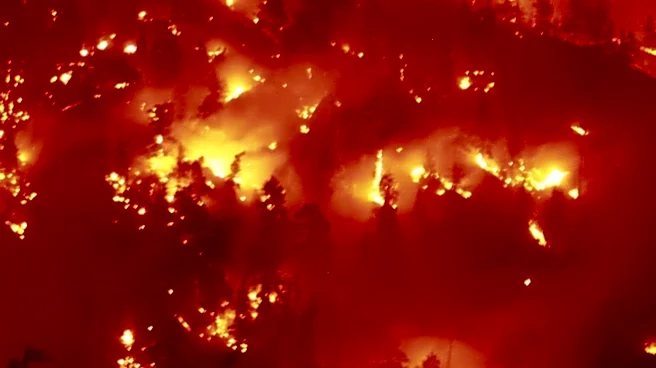
Wildfires across the United States are increasingly intense, fundamentally altering forest landscapes in ways that prevent traditional recovery, according to researchers. Monica Turner, a professor at the University of Wisconsin-Madison, observed significant
destruction in Yellowstone National Park in 2017, where only about 5% of tree seedlings have regrown since the 2016 Maple Fire. Similarly, Derek Young, a research ecologist at the University of California, Davis, notes that areas in California's Plumas National Forest, devastated by the 2021 Dixie Fire, are transforming into shrublands rather than recovering as forests. Chris Guiterman, a research scientist at the Cooperative Institute for Research in Environmental Sciences at the University of Colorado Boulder, highlights similar shifts in New Mexico's Sugarite Canyon State Park, where intense fires are killing trees that previously survived, leading to a conversion from pine-dominated forests to drought-resistant oak shrubs. This trend is attributed to a lack of prescribed burning, a practice historically used to maintain healthy landscapes, which has left forests vulnerable to hotter, more vicious fires.
Why It's Important?
The transformation of U.S. forests into shrublands or grasslands due to increasingly intense wildfires has significant ecological and societal implications. Forests play a crucial role in carbon sequestration, and their destruction releases carbon, contributing to climate change and creating a feedback loop that makes more fires likely. This shift also impacts wildlife habitats, water availability, and recreational activities, potentially altering how and when people visit national parks like Yellowstone. The loss of towering trees for shade and aesthetic value could diminish the appeal of these natural areas. While some ecosystems, like Florida's pine savannas, are adapted to fire and benefit from prescribed burns, many western U.S. forests are struggling to recover, leading to a permanent change in their composition. This highlights a critical challenge in land management and climate adaptation, as traditional forest recovery models are no longer sufficient.
What's Next?
Researchers anticipate a gradual conversion of once-towering forests into robust scrublands or grasslands across many parts of the U.S., particularly in the Southwest. The future of these landscapes is uncertain, with scientists like Monica Turner suggesting there won't be a single tipping point but rather multiple responses from the ecosystem to various pressures. Efforts to reintroduce prescribed burning, as seen in Florida, could be crucial for managing fire-adapted ecosystems and reducing the intensity of future wildfires. However, public education on the benefits of prescribed burns is a significant hurdle, especially in growing states where new residents may not understand the practice. Continued research into post-fire recovery and adaptation strategies will be essential to understand and mitigate the long-term impacts of these changing fire regimes on U.S. natural resources and communities.
Beyond the Headlines
The shift in U.S. forest landscapes due to intense wildfires raises deeper questions about humanity's relationship with nature and the long-term consequences of fire suppression policies. For decades, fire suppression created an unnatural accumulation of fuel, making current fires more severe. This situation forces a reevaluation of what constitutes a 'healthy' ecosystem, moving beyond a static ideal to one that acknowledges dynamic change. The ethical dimension involves balancing human values, such as the desire for pristine forests, with ecological realities and the need for adaptive management. The legal and policy implications include developing more effective land management strategies, potentially involving increased funding and support for prescribed burning programs, and addressing the challenges of public perception and education. This ongoing transformation underscores the profound and complex interplay between climate change, human intervention, and natural processes.