




What's Happening?
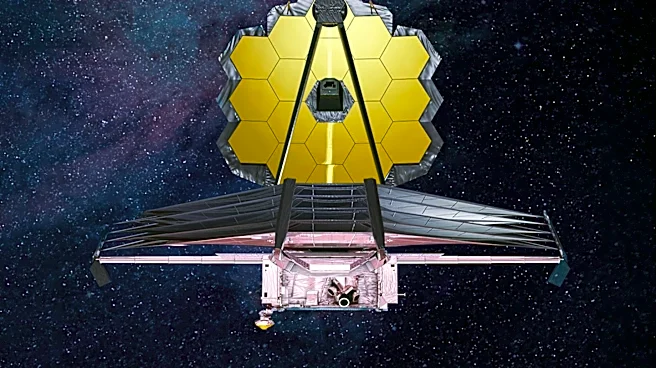
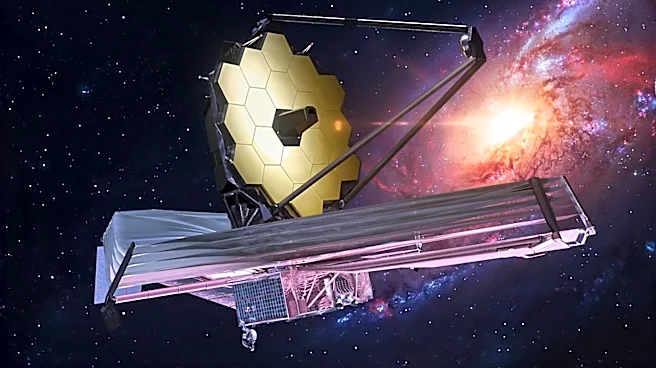
Astronomers utilizing the NASA/ESA/CSA James Webb Space Telescope (JWST) have been examining young stellar systems, specifically a class known as 'Extreme Debris Disks,' to understand the aftermath of planetary collisions. These observations provide crucial
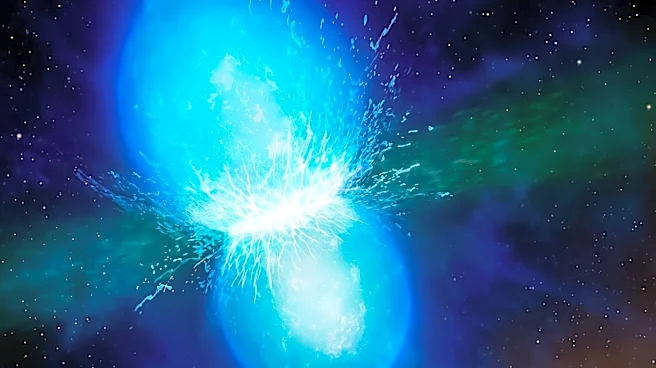
insights into how planets form and evolve. The study involved analyzing 21 such debris disks, with 16 observed by the JWST and 5 from the Spitzer telescope archive. Researchers found that the composition of the dust in these disks reveals the intensity of the collisions and the size of the celestial bodies involved. Approximately one-third of the observed disks are rich in silicates, indicating high-energy impacts between Mars-sized objects, similar to the hypothesized formation of Earth's Moon. The remaining two-thirds are silicate-poor, suggesting lower-energy, glancing collisions between Moon-sized objects. This research offers an unprecedented opportunity to study the 'crime scenes' of cosmic impacts, providing a window into the violent history of planetary system formation.
Why It's Important?
This research is important because it provides direct observational evidence supporting theories of planetary formation, particularly the role of violent collisions in shaping young solar systems. The ability of the JWST to analyze the metallic fingerprints of dust left behind after these impacts allows scientists to infer the size and energy of the colliding bodies, which was previously difficult to ascertain. Understanding these processes helps refine models of how rocky planets, including Earth, came into existence. The distinction between silicate-rich and silicate-poor disks, and their correlation with the age of the stars, offers a timeline for when different types of collisions are most prevalent during a system's development. This knowledge is fundamental to astrobiology and the search for exoplanets, as it helps define the conditions under which potentially habitable worlds might form.
What's Next?
Future research will likely involve expanding the sample size of 'Extreme Debris Disks' observed by the James Webb Space Telescope to further refine the statistical understanding of planetary collision types and their frequency. Scientists will continue to analyze the detailed chemical compositions of the dust in these disks to gain more precise information about the materials involved in these cosmic impacts. This will help in developing more accurate models of planet formation and evolution. The insights gained could also guide the search for exoplanets by identifying systems that have undergone similar formation processes to our own solar system, potentially increasing the chances of discovering Earth-like planets. Continued observations will also aim to identify any direct evidence of protoplanetary bodies within these debris disks, which remain challenging to detect due to their small size.
Beyond the Headlines
The deeper implications of this research extend to our fundamental understanding of the universe's architecture and the prevalence of planetary systems. By demonstrating that violent collisions are a common and integral part of planet formation, this study reinforces the dynamic and often chaotic nature of early solar systems. It suggests that the formation of Earth's Moon, a result of a massive impact, might not be an anomaly but rather a common occurrence in the development of rocky planets. This perspective could influence theories on the distribution of water and other essential elements for life across different planetary bodies, as these collisions can redistribute materials. Furthermore, the ability to 'read' the remnants of these ancient cosmic events highlights the power of advanced astronomical instruments like the JWST in unraveling the universe's history, pushing the boundaries of what we can observe and deduce about distant worlds.