






What's Happening?
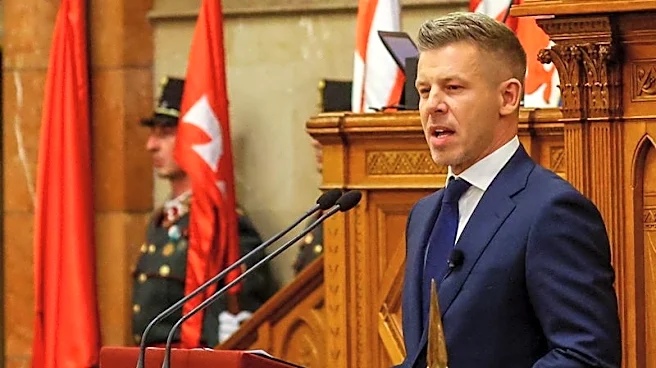
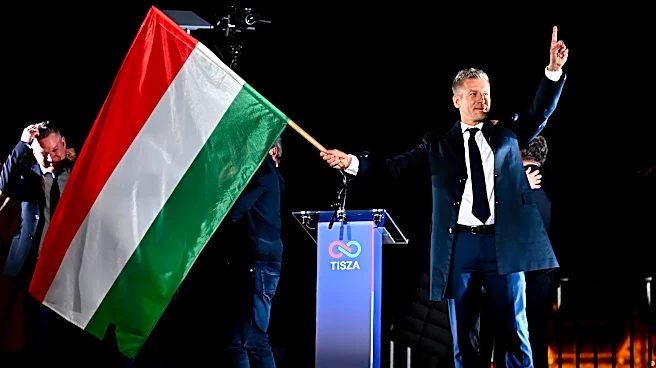
Peter Magyar has officially taken office as Hungary's new Prime Minister, following a decisive victory in the recent parliamentary elections. Magyar, who leads the center-right Tisza party, succeeded Viktor Orban, who had been in power for 16 years. The
election results granted Magyar's party a significant majority in parliament, securing 141 out of 199 seats. His campaign focused on promises of change, particularly addressing economic stagnation and strained relations with the European Union that characterized Orban's tenure. The swearing-in ceremony took place in Hungary's neo-Gothic parliament building, where the EU flag was reinstated after being removed during Orban's administration. This move symbolizes a potential shift in Hungary's approach to its relationship with the EU.
Why It's Important?
Magyar's appointment as Prime Minister marks a significant political shift in Hungary, potentially altering the country's domestic and international policies. Under Orban, Hungary experienced economic challenges and deteriorating relations with the EU, partly due to Orban's close ties with Moscow and opposition to EU sanctions on Russia. Magyar's leadership could lead to improved relations with the EU, especially as he seeks to unlock approximately $20 billion in frozen EU funds. These funds were withheld due to concerns over human rights and the rule of law under Orban. Magyar's ability to navigate these challenges will be crucial for Hungary's economic recovery and its reintegration into the EU's political framework.
What's Next?
As Prime Minister, Magyar faces the immediate challenge of restoring Hungary's relations with the EU and addressing the country's economic issues, including a significant budget deficit. His administration will need to demonstrate a clear departure from Orban's policies to gain the trust of both domestic and international stakeholders. Additionally, Magyar will need to manage the bureaucratic structures left by Orban's long tenure, which could pose obstacles to implementing new policies. The success of Magyar's government will largely depend on its ability to negotiate with the EU and secure the release of the frozen funds, which are vital for Hungary's economic stability.
Beyond the Headlines
Magyar's rise to power is seen as a turning point in Hungarian politics, reflecting a shift in public sentiment away from Orban's regime. This change could have broader implications for the political landscape in Central Europe, where populist and nationalist movements have gained traction. Magyar's leadership may influence similar political shifts in neighboring countries, potentially altering the region's approach to EU relations and governance. Furthermore, the reinstatement of the EU flag in Hungary's parliament is a symbolic gesture that may encourage other EU member states to reconsider their positions on Hungary's political alignment.