




What's Happening?
A magnitude 6.4 earthquake has struck Papua New Guinea, an island nation located within the seismically active Pacific Ring of Fire. The U.S. Geological Survey (USGS) reported that the quake occurred at a depth of approximately 64 miles, about 30 miles from
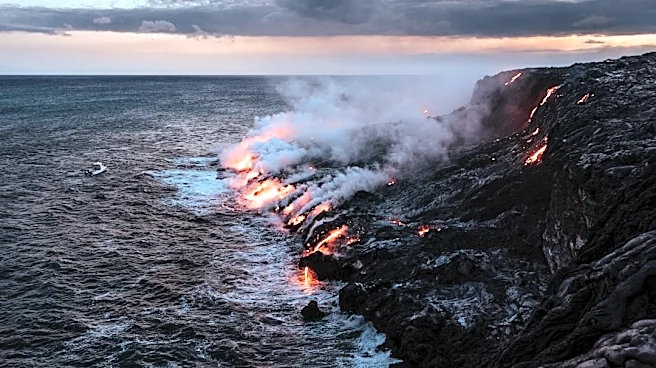
Kainantu. Shaking was felt across the country. The USGS noted that the population in the affected area resides in structures that are a mix of vulnerable and earthquake-resistant construction. Historically, this region has experienced secondary hazards such as landslides and liquefaction following seismic events. Papua New Guinea is situated along the Australia-Pacific plate boundary, a 2,500-mile-long fault line that extends from the Sunda (Java) trench to the Solomon Islands. The Pacific Ring of Fire is known for hosting about 90% of the world's earthquakes and 75% of its active volcanoes, stretching approximately 25,000 miles in a horseshoe shape.
Why It's Important?
This earthquake underscores the persistent seismic risk faced by communities located along the Pacific Ring of Fire. For Papua New Guinea, a nation with diverse infrastructure, the mix of vulnerable and earthquake-resistant buildings raises concerns about potential damage and casualties, particularly in remote areas where emergency response might be challenging. The historical occurrence of secondary hazards like landslides and liquefaction further amplifies the danger, as these can cause significant destruction and hinder rescue efforts even after the initial shaking subsides. Understanding the geological context of the Pacific Ring of Fire is crucial for disaster preparedness and mitigation strategies in these regions. The frequent seismic activity necessitates continuous investment in resilient infrastructure, early warning systems, and public education to minimize the impact on human lives and livelihoods. The event also serves as a reminder of the dynamic geological processes shaping our planet.
What's Next?
Authorities in Papua New Guinea will likely focus on assessing the extent of damage, identifying any casualties, and providing immediate aid to affected communities. Emergency response teams will be deployed to conduct search and rescue operations, particularly in areas prone to landslides or with vulnerable infrastructure. Geologists and seismologists will continue to monitor aftershocks and analyze the earthquake's data to better understand the fault mechanics and potential future seismic activity in the region. International aid organizations may offer assistance in recovery and reconstruction efforts. In the long term, there may be renewed emphasis on improving building codes, strengthening infrastructure, and enhancing disaster preparedness programs across Papua New Guinea and other nations within the Pacific Ring of Fire to better withstand future seismic events. Public awareness campaigns about earthquake safety and evacuation procedures will also be critical.
Beyond the Headlines
The recurring seismic events in the Pacific Ring of Fire highlight the complex interplay between geological forces and human vulnerability. Beyond the immediate humanitarian concerns, these events often trigger broader discussions about sustainable development in high-risk zones. They challenge communities to balance economic growth with the imperative of resilience, prompting questions about land use planning, urban development, and the equitable distribution of resources for disaster preparedness. The scientific study of these earthquakes also contributes to a deeper understanding of plate tectonics and seismic forecasting, which has global implications for mitigating earthquake risks worldwide. Furthermore, the cultural and social impacts of living in such an active geological region are profound, often shaping local traditions, beliefs, and community solidarity in the face of recurrent natural disasters. The event serves as a stark reminder of humanity's ongoing challenge to coexist with powerful natural phenomena.