




What's Happening?
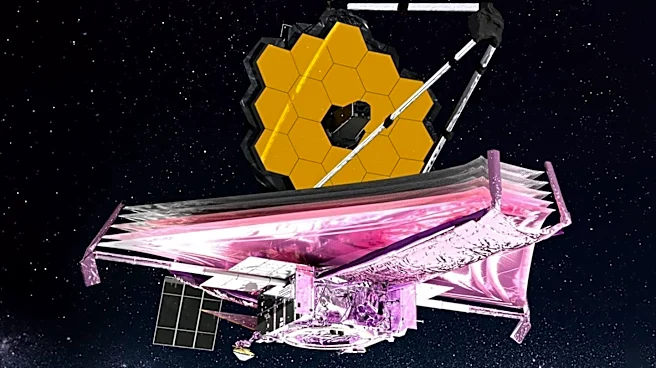
The James Webb Space Telescope (JWST) has detected both water and carbon dioxide ice in the debris disk surrounding Beta Pictoris, a young star approximately 20 million years old and 64 light-years from Earth. A new study published in Science, led by
Sarah Betti, an astronomer at the Space Telescope Science Institute in Baltimore, revealed that this ice is glassy rather than crystalline and is mixed with carbon dioxide in proportions similar to comets in our own Solar System. Crucially, researchers concluded that this ice likely formed in the interstellar medium, existing long before the planets of Beta Pictoris began to take shape. This finding suggests that the ingredients necessary for forming water-rich worlds might be common around young stars. Beta Pictoris is a well-studied star with a disk where planets are still forming, and three have already been discovered.
Why It's Important?
This discovery is significant because it provides direct evidence that the building blocks for water-rich planets can predate the formation of their host stars. The presence of ancient, amorphous ice in the Beta Pictoris disk suggests that the raw materials for planetary systems are inherited from the interstellar medium, rather than being solely formed within the protoplanetary disk itself. This challenges previous assumptions about the origins of water and other volatile molecules in young stellar systems. Understanding the composition and origin of these icy materials is crucial for comprehending how planets, particularly those with the potential for life, acquire their water and atmospheric components. The findings also highlight the unparalleled capabilities of the James Webb Space Telescope in probing the chemical makeup of distant stellar nurseries and exoplanetary systems.
What's Next?
Future research will likely focus on further characterizing the composition and distribution of ice in the Beta Pictoris disk and other young stellar systems. Astronomers will aim to determine if this ancient, interstellar ice is a common feature across various protoplanetary disks or if Beta Pictoris represents a unique case. The JWST's continued observations will be instrumental in this effort, providing high-resolution spectroscopic data that can reveal the chemical signatures of different ice types and their spatial variations. Scientists will also work to refine models of planet formation to incorporate the role of inherited interstellar materials, potentially leading to a more comprehensive understanding of how planetary systems, including our own, came to be. The study of Beta Pictoris will continue to serve as a natural laboratory for observing planet formation in action.
Beyond the Headlines
The detection of ice older than the star it orbits has profound implications for astrobiology and the search for life beyond Earth. If the fundamental ingredients for water-rich worlds are common and predate star formation, it suggests that the potential for habitable environments might be more widespread in the universe than previously thought. This finding strengthens the idea that the chemical complexity necessary for life can be 'seeded' into nascent planetary systems from the vast cosmic reservoir of the interstellar medium. It also underscores the dynamic nature of star and planet formation, where materials are constantly recycled and transformed across cosmic timescales. The ability of the JWST to uncover such ancient and fundamental components of planetary systems opens new avenues for exploring the origins of life and the distribution of water in the cosmos.