
What's Happening?
A study led by University of Pennsylvania cosmologist Patricio A. Gallardo has confirmed that Newton's law of gravity holds true even on cosmic scales, reinforcing the existence of dark matter. Using data
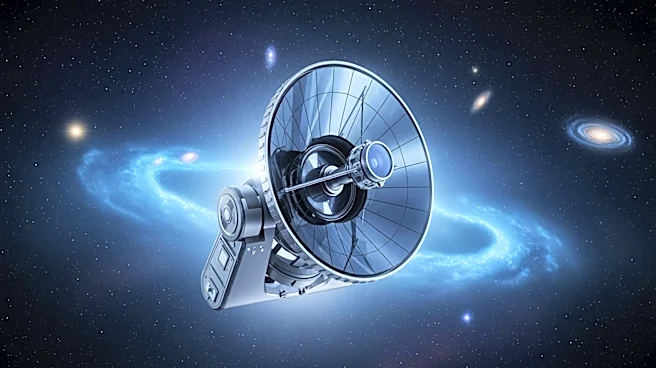
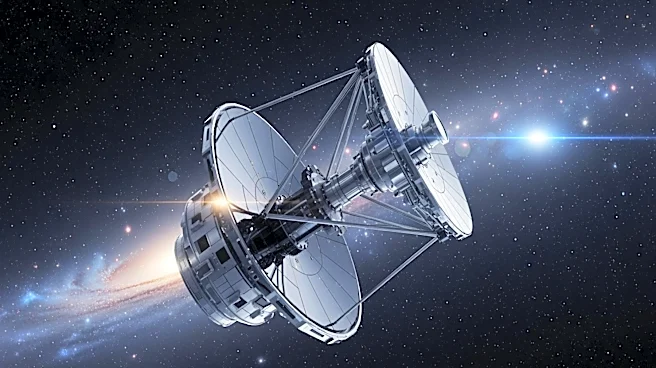
from the Atacama Cosmology Telescope, researchers tested gravity across galaxy clusters separated by hundreds of millions of light-years. Their findings, published in Physical Review Letters, show that gravitational strength decreases with distance as predicted by Newton and Einstein's theories. This supports the presence of unseen dark matter, as the observed gravitational effects cannot be explained by visible matter alone. The study challenges alternative theories like Modified Newtonian Dynamics (MOND) that suggest altering gravitational laws.
Why It's Important?
The confirmation of Newton's gravitational law on such a large scale strengthens the standard model of cosmology, which relies on the existence of dark matter to explain the universe's structure and behavior. This finding has significant implications for astrophysics, as it supports the idea that dark matter is a fundamental component of the universe, influencing the motion of stars and galaxies. Understanding dark matter is crucial for explaining cosmic phenomena and could lead to breakthroughs in physics. The study also highlights the importance of advanced observational tools like the Atacama Cosmology Telescope in testing fundamental scientific theories.
What's Next?
Future observations of the cosmic microwave background and expanded galaxy surveys are expected to provide even more precise tests of gravity. These efforts aim to further understand the nature of dark matter and its role in the universe. Researchers will continue to explore alternative theories and refine their models to account for any discrepancies. The ongoing study of gravity and dark matter remains a key area of research in cosmology, with the potential to unlock new insights into the universe's fundamental properties.