
What's Happening?
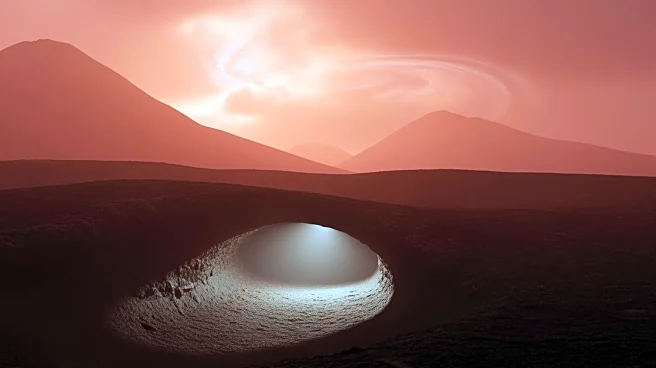
Researchers have proposed the existence of massive lava tubes beneath the surface of Venus, as detailed in a paper accepted for publication in the journal Icarus. These structures, formed by volcanic activity,
could be significantly larger than those found on Earth, Mars, or the Moon. The study suggests that Venus's lower surface gravity allows for the stability of tubes up to 0.62 miles wide. Despite the planet's extreme conditions, which include high temperatures and atmospheric pressure, the potential discovery of these tubes could provide valuable information about Venus's geological history.
Why It's Important?
The discovery of lava tubes on Venus could have significant implications for our understanding of planetary geology and the history of volcanic activity in the solar system. These structures might offer clues about the planet's past, including its volcanic processes and potential for past habitability. Additionally, studying Venus's lava tubes could inform future exploration missions, as they may serve as natural shelters for robotic probes or, eventually, human explorers. Understanding these formations could also aid in the search for similar structures on other planets, contributing to broader planetary science research.
What's Next?
Future missions to Venus, such as NASA's DAVINCI and VERITAS, are expected to provide more detailed data on the planet's surface and subsurface features. These missions aim to use advanced imaging and geophysical techniques to confirm the existence of lava tubes and explore their characteristics. The continuation of these missions depends on funding and political support, as past budget proposals have threatened their viability. Successful exploration of Venus's lava tubes could pave the way for more ambitious missions and enhance our understanding of the planet's geology.
Beyond the Headlines
The study of Venus's lava tubes also raises questions about the potential for life in extreme environments. While Venus is currently inhospitable, understanding its geological features could provide insights into the conditions necessary for life to exist elsewhere in the universe. The research highlights the importance of interdisciplinary collaboration in planetary science, combining geology, astronomy, and engineering to explore and understand our solar system's diverse environments.