






What's Happening?
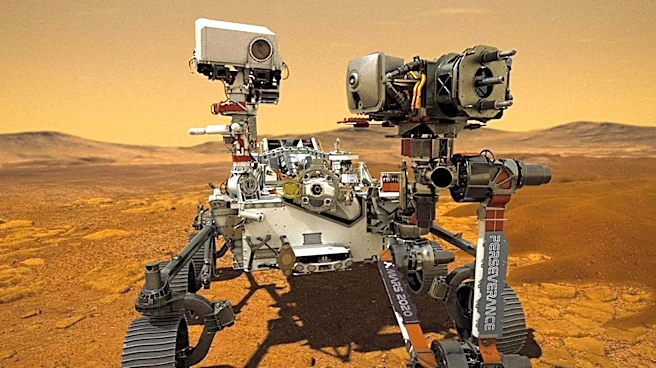
NASA's Perseverance rover has discovered complex organic carbon in two ancient mudstones within the Jezero crater on Mars. The findings, published in Science Advances, reveal macromolecular carbon, a type of large, cross-linked carbon molecule associated
with living chemistry on Earth. The study, led by Ashley Murphy of the Planetary Science Institute, highlights hundreds of organic detections across the rocks, marking the most robust organic result from Jezero to date. The organics were found in two distinct chemical settings: one associated with secondary minerals deposited by fluid movement, and the other bound within the primary silicate matrix of the mudstone. This suggests that organic chemistry was a recurring feature in ancient Jezero, rather than a singular event.
Why It's Important?
The detection of complex organic carbon on Mars is significant as it provides insights into the planet's ancient chemistry and potential for life. While macromolecular carbon can arise through biological processes on Earth, it can also form through non-biological means such as meteorite delivery and volcanic activity. The inability of the Perseverance rover to distinguish between biological and geological origins of the carbon highlights the need for further analysis. The discovery underscores the importance of retrieving the cached samples for detailed examination on Earth, which could potentially confirm or refute the presence of past life on Mars.
What's Next?
The future of Mars sample retrieval is uncertain following the U.S. government's decision to end the Mars Sample Return program. The samples remain on Mars, with no funded mission to collect them. However, alternative retrieval concepts, commercial partnerships, or international efforts, such as China's sample-return plans, may offer solutions. The timeline is critical, as Perseverance's plutonium power source will eventually deplete, limiting further exploration capabilities.
Beyond the Headlines
The discovery of organic carbon on Mars raises broader questions about the planet's habitability and the potential for life beyond Earth. It challenges scientists to consider the diverse pathways through which organic molecules can form and persist in extraterrestrial environments. The findings also highlight the limitations of current rover technology in answering fundamental questions about life on Mars, emphasizing the need for advanced laboratory analysis.