
What's Happening?
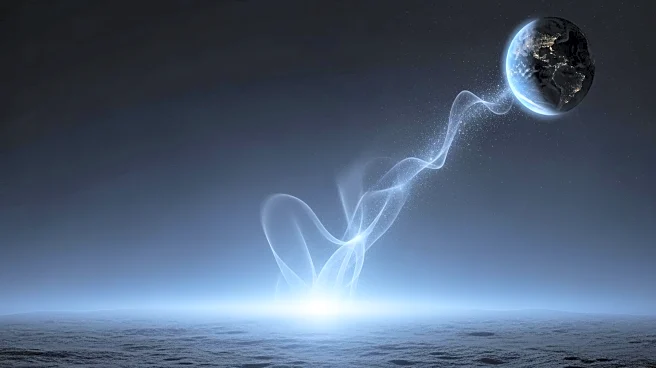
New research has revealed that Earth's atmosphere is gradually leaking into space, with the Moon collecting these atmospheric particles over billions of years. This process occurs as Earth's magnetic field,
instead of acting as a perfect barrier, allows atmospheric ions to escape and be deposited on the Moon's surface. The Moon's soil, therefore, contains traces of Earth's ancient atmosphere, providing a unique archive of the planet's past. This discovery challenges previous assumptions about Earth's magnetic field and its role in atmospheric retention.
Why It's Important?
The findings have significant implications for understanding Earth's atmospheric history and the role of its magnetic field. By analyzing the isotopic compositions in lunar soil, scientists can gain insights into Earth's atmospheric evolution, including periods of volcanic activity and climate change. This research could also inform studies of atmospheric dynamics on other planets, such as Mars and Venus, and even exoplanets. The Moon's role as an atmospheric archive opens new avenues for planetary science and could enhance our understanding of Earth's environmental past.
What's Next?
Future lunar missions may focus on collecting samples from the Moon's farside, which has limited exposure to Earth's magnetotail. These samples could provide further evidence of Earth-origin particles on the Moon. As lunar exploration continues, researchers will likely conduct more detailed analyses of lunar soil to uncover additional insights into Earth's atmospheric history. This research could also influence the planning of future space missions and the development of new technologies for studying planetary atmospheres.