
What's Happening?
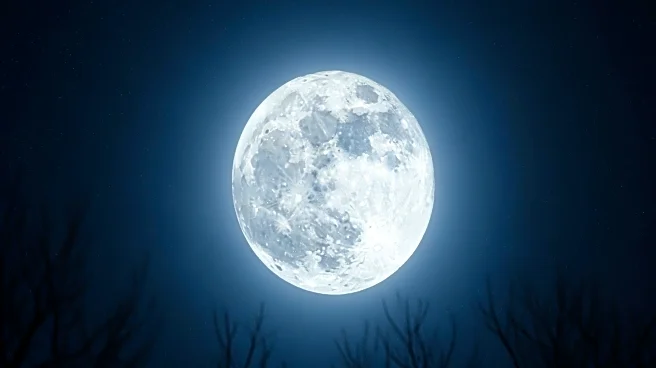
In 2026, skywatchers in North America will have the opportunity to observe 13 full moons, including three supermoons and two lunar eclipses. The year will begin with the Wolf Moon on January 3, which is
also a supermoon, appearing larger and brighter due to its proximity to Earth. A total lunar eclipse, known as a 'blood moon,' will occur on March 2-3, when the Worm Moon will pass through Earth's umbral shadow, turning a reddish-orange color. This event will be visible from western North America and the Asia Pacific. Another notable event is the partial lunar eclipse on August 27-28, during which the Sturgeon Moon will be partially obscured. The year will also feature a Blue Moon on May 31 and several other traditionally named full moons, such as the Pink Moon in April and the Harvest Moon in September.
Why It's Important?
The full moons and eclipses of 2026 offer significant opportunities for both amateur and professional astronomers to observe and study lunar phenomena. These events are not only visually spectacular but also provide valuable data for scientific research. The total lunar eclipse in March, visible from North America, is particularly noteworthy as it will be the last total lunar eclipse until 2028. Such celestial events can inspire public interest in astronomy and science, potentially influencing educational programs and public outreach initiatives. Additionally, the occurrence of supermoons can affect tidal patterns, which may have implications for coastal communities and ecosystems.
What's Next?
As 2026 approaches, astronomers and enthusiasts will prepare for these celestial events by organizing viewing parties and educational programs. Observatories and science centers may host special events to engage the public and provide educational resources. The total lunar eclipse in March is expected to draw significant attention, with potential media coverage and live broadcasts. Researchers may also use these events to conduct studies on lunar surface conditions and atmospheric effects. The anticipation of these events could lead to increased interest in astronomy-related activities and educational pursuits.
Beyond the Headlines
The cultural significance of full moons and lunar eclipses extends beyond scientific interest. Many cultures have traditional names and folklore associated with each full moon, reflecting agricultural cycles and historical practices. The visibility of these events across North America provides an opportunity for cultural exchange and appreciation of diverse lunar traditions. Additionally, the study of lunar eclipses contributes to our understanding of Earth's atmosphere, as the color changes during an eclipse are influenced by atmospheric conditions. This can provide insights into climate patterns and environmental changes.