
What's Happening?
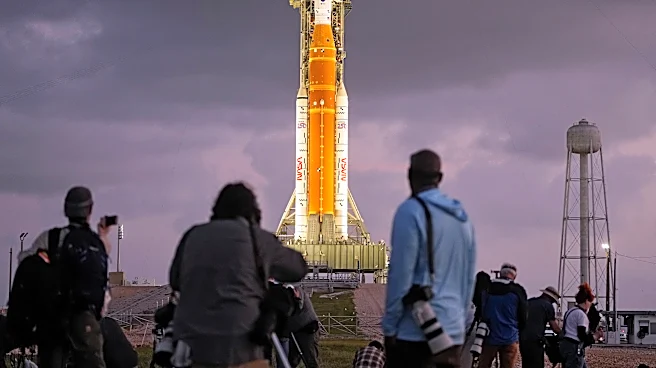
NASA's Artemis II mission has launched, marking a significant milestone in space exploration. The mission involves four astronauts aboard the Orion spacecraft, named Integrity, on a journey to the Moon.
This mission is the first crewed voyage beyond low-Earth orbit in over fifty years, aiming to test NASA's modern deep-space systems. The crew, consisting of Commander Reid Wiseman, Pilot Victor Glover, Mission Specialist Christina Koch, and Canadian astronaut Jeremy Hansen, will validate life-support systems, communication links, navigation, and re-entry capabilities in cislunar space. The mission, launched from Kennedy Space Center, is set to reach the Moon's vicinity by April 6, 2026, before returning to Earth on April 10, 2026.
Why It's Important?
The Artemis II mission is crucial for the future of lunar exploration and potential Mars missions. By testing deep-space systems, NASA aims to ensure the safety and productivity of astronauts in harsh environments far from Earth. This mission serves as a bridge between the Apollo era and future Artemis missions, paving the way for sustainable lunar exploration. The success of Artemis II could lead to advancements in space technology and international collaboration, as demonstrated by the inclusion of Canadian astronaut Jeremy Hansen. The mission also represents progress in diversity, with Victor Glover being one of NASA's few Black astronauts and Christina Koch as the first woman on a lunar trajectory.
What's Next?
Following the Artemis II mission, NASA plans to conduct further Artemis missions, including a lunar landing. The data collected from this mission will inform future designs and strategies for long-duration space travel. The success of Artemis II could accelerate plans for Mars exploration, with NASA aiming to establish a sustainable presence on the Moon as a stepping stone. The international collaboration seen in Artemis II may expand, potentially involving more countries in future missions. Stakeholders, including government agencies and private companies, will likely analyze the mission's outcomes to enhance space exploration technologies.
Beyond the Headlines
The Artemis II mission highlights ethical and cultural dimensions in space exploration, such as the importance of diversity and international cooperation. The inclusion of diverse astronauts reflects a broader commitment to representation in space missions. The mission also raises questions about the long-term impact of human presence in space, including environmental considerations and the potential for new scientific discoveries. As humanity ventures further into space, discussions around space governance and ethical exploration practices may become more prominent.