







What's Happening?
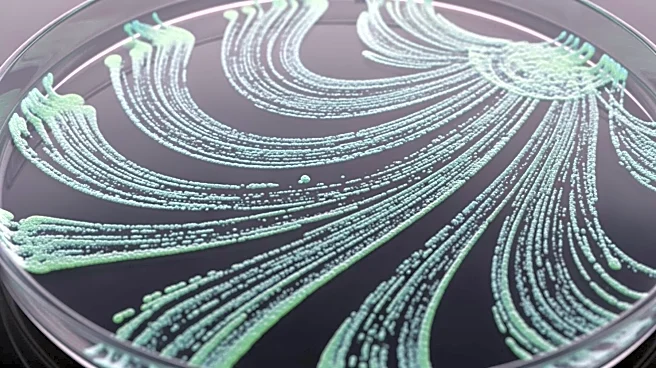
Researchers from Flinders University have uncovered a novel behavior in bacteria, demonstrating their ability to self-organize and migrate over long distances in coordinated communities. The study, published in Nature Communications, involved tracking
sewage-derived microbial communities in a tube system, revealing that these bacteria form visible migrating bands. These bands, which include viruses and non-swimming microbes, travel over several meters, increasing in speed as they progress. The research highlights the complexity of microbial ecosystems, showing that bacteria do not migrate as solitary entities but as part of diverse communities that adapt and evolve during their journey.
Why It's Important?
This discovery has significant implications for understanding microbial behavior in various contexts. In medicine, it provides insights into how non-swimming pathogens might spread within the human body or healthcare environments by hitching rides with mobile bacterial communities. Environmentally, the findings suggest mechanisms by which ecosystems maintain biodiversity and resilience, allowing rare microbes to colonize new habitats and support processes like soil health and wastewater treatment. The study underscores the importance of microbial diversity and cooperation in natural and engineered systems, potentially influencing future research and applications in microbiology and environmental science.
What's Next?
Future research may focus on exploring the specific mechanisms that enable bacteria to self-organize and migrate in such coordinated ways. Understanding these processes could lead to advancements in controlling microbial spread in medical settings and enhancing the efficiency of bioremediation and wastewater treatment. Additionally, the study's findings could inspire new strategies for managing microbial communities in agriculture and other industries, promoting sustainability and resilience in various ecosystems.
Beyond the Headlines
The study challenges traditional views of bacterial behavior, emphasizing the role of community dynamics over individual actions. This perspective could shift how scientists approach microbial research, focusing more on interactions and collective behaviors. The implications extend to ethical considerations in biotechnology, where manipulating microbial communities could have unforeseen consequences. As researchers continue to unravel the complexities of microbial ecosystems, the balance between innovation and ecological impact will be crucial.