
What's Happening?
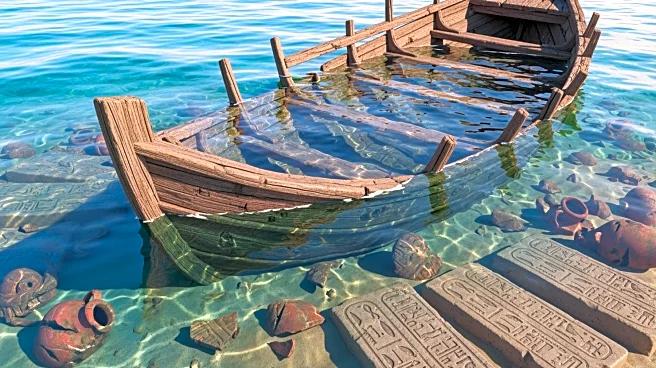
Underwater archaeologists have uncovered the remains of a 2,000-year-old shipwreck off the coast of Alexandria, Egypt. The vessel, believed to be a luxurious 'pleasure barge' from the Ptolemaic period,
was found in the ancient harbor of Alexandria. The shipwreck consists of well-preserved timbers, measuring about 90 feet in length, and is thought to have been part of a larger barge approximately 115 feet long. French underwater archaeologist Franck Goddio, who led the excavation, suggests that the barge, known as a 'thalamagos,' served as a floating palace for the ancient elite. The discovery was made near the sunken ruins of a Temple of Isis on the island of Antirhodos, which was submerged following an earthquake around A.D. 50. The barge may have been used for ritual purposes, possibly as part of the 'navigatio iside,' a naval ceremony celebrating the goddess Isis.
Why It's Important?
This discovery provides significant insights into the luxurious lifestyles and religious practices of the Ptolemaic and early Roman periods in Egypt. The 'pleasure barge' highlights the opulence of the era, reflecting the wealth and power of the ruling elite. Additionally, the find contributes to the understanding of ancient naval architecture and the use of waterways for ceremonial purposes. The potential ritual use of the barge underscores the cultural and religious significance of maritime activities in ancient Egypt. This archaeological find not only enriches historical knowledge but also enhances the cultural heritage of Alexandria, a city with a rich and complex history.
What's Next?
Further research and analysis of the shipwreck are expected to provide more detailed information about its construction, use, and historical context. Archaeologists will continue to study the site to determine the exact role of the barge in ancient Egyptian society. The findings may lead to new interpretations of the Ptolemaic and Roman periods in Egypt, offering a deeper understanding of the region's history. Preservation efforts will be crucial to protect the site and its artifacts, ensuring that they remain accessible for future study and public education.