
What's Happening?
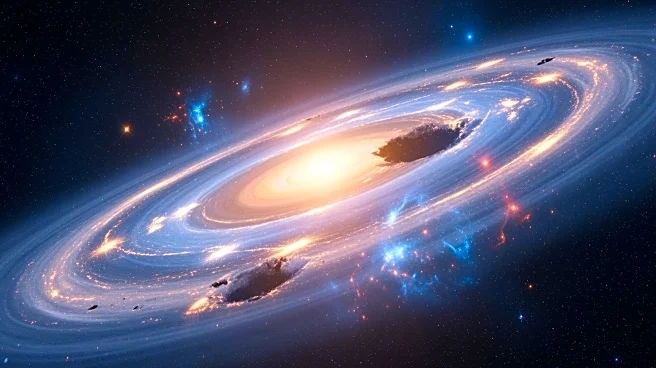
Astronomers using NASA's Hubble Space Telescope have captured images of the largest protoplanetary disk ever observed, located around 1,000 light-years from Earth. This disk, named IRAS 23077+6707 and
nicknamed 'Dracula's Chivito,' spans nearly 400 billion miles, making it 40 times the diameter of our solar system. The disk is notable for its chaotic and turbulent nature, with wisps of material extending far above and below the disk, a feature not commonly seen in similar systems. The disk obscures a young star, which could be a massive star or a pair of stars. The findings, published in The Astrophysical Journal, provide a new perspective on planet formation in extreme environments.
Why It's Important?
The discovery of such a massive and chaotic protoplanetary disk is significant for understanding planet formation. The disk's mass, estimated to be 10 to 30 times that of Jupiter, suggests the potential for forming multiple gas giants. This system offers a unique laboratory for studying the processes that shape planetary systems, which could differ significantly in such massive environments. The asymmetry and dynamic processes observed in the disk provide insights into the complex interactions that occur during planet formation. These findings could reshape current models of how planets form and evolve, offering a broader understanding of planetary systems beyond our own.
What's Next?
The new images from Hubble open up opportunities for further study of IRAS 23077+6707. Researchers aim to explore the underlying processes of planet formation in such massive environments. Future observations, potentially involving NASA's James Webb Space Telescope, could provide more detailed insights into the disk's structure and the dynamics at play. Understanding these processes could lead to breakthroughs in our knowledge of planet formation and the diversity of planetary systems in the universe.
Beyond the Headlines
The peculiar structure of IRAS 23077+6707, with its asymmetric features and dynamic processes, challenges existing theories of planet formation. The disk's chaotic nature suggests that planet nurseries can be more active than previously thought. This discovery highlights the importance of continued exploration and observation of distant planetary systems to refine our understanding of the universe. The collaboration between NASA and the European Space Agency in operating the Hubble Space Telescope underscores the global effort in advancing astronomical research.