







What's Happening?
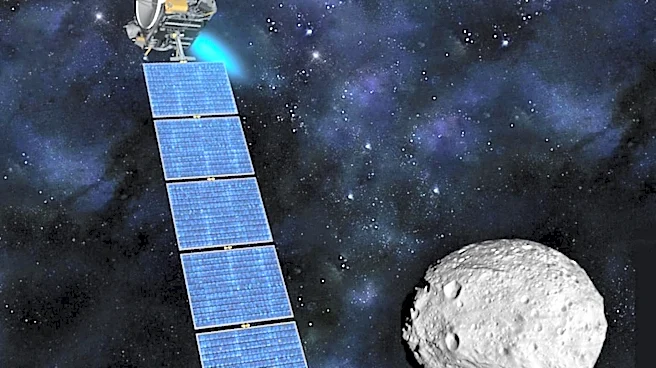
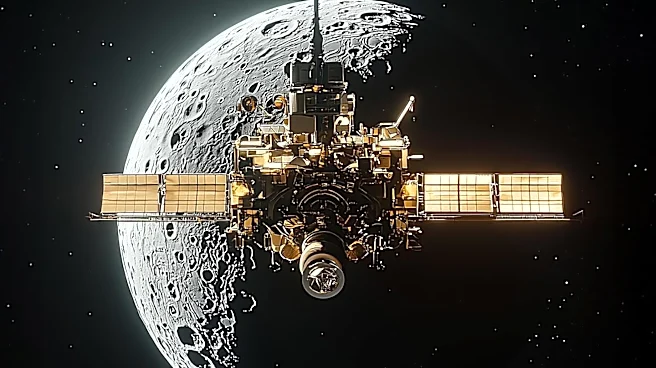
The United Arab Emirates (UAE) has developed an asteroid lander designed to intentionally crash into the asteroid 269 Justitia. This probe is part of the Emirates Mission to the Asteroid Belt (EMA), which aims to visit seven asteroids. The main spacecraft,
MBR Explorer, will utilize gravity assist maneuvers around Venus, Earth, and Mars to approach six asteroids before reaching Justitia. The lander, built by Abu Dhabi's Technology Innovation Institute (TII), will be deployed from the MBR Explorer in early 2036, after an approximately eight-year journey covering about 5 billion kilometers. Upon arrival, the probe is expected to impact 269 Justitia at speeds between 15 to 27 meters per second (34 to 60 mph) without any braking mechanism. Researchers do not anticipate the probe to survive the touchdown, but the impact is intended to create a small hole, potentially exposing subsurface materials not visible through orbital observation. The mission's launch window is critical, opening for three weeks in early March 2028, with no similar opportunities for the next 100 years. The lander will use AI to determine optimal timing for picture-taking and will transmit the best images every six months.
Why It's Important?
This mission represents a significant advancement in asteroid exploration and planetary science, offering a unique approach to studying the composition and origins of celestial bodies. By intentionally crashing a probe, scientists aim to access pristine subsurface materials of 269 Justitia, an asteroid believed to have formed in the outer solar system and potentially containing water-related minerals and organic compounds. Such data could provide crucial insights into the early solar system, the distribution of water, and the potential for life beyond Earth. For the UAE, this mission solidifies its growing presence and capabilities in space exploration, demonstrating its commitment to scientific research and technological innovation. The use of AI for autonomous image selection and transmission highlights cutting-edge technological integration in deep space missions, which could influence future mission designs globally. The mission's success could also inspire other nations to pursue ambitious and unconventional methods for space exploration, fostering international collaboration and competition in the field of planetary science. The insights gained could also contribute to planetary defense strategies by enhancing understanding of asteroid compositions and behaviors.
What's Next?
The immediate next step for the EMA mission is the critical launch in early March 2028. The success of this launch within the narrow three-week window is paramount, as mission director Mohsen al-Awadhi has stated there will be no other similar opportunities for a century. Following a successful launch, the MBR Explorer will embark on its multi-year journey, performing gravity assist maneuvers and conducting flybys of six asteroids before deploying the lander. The probe's journey will involve autonomous operations, including AI-driven image capture and transmission. Scientists and engineers will closely monitor the probe's trajectory and health throughout its transit. The ultimate event to watch will be the intentional crash into 269 Justitia in early 2036, followed by the analysis of the transmitted images and data. The findings from this impact are expected to generate significant scientific interest and contribute to ongoing research into asteroid characteristics and the origins of the solar system. The mission's outcomes could also inform future asteroid mining concepts and planetary defense strategies.
Beyond the Headlines
The UAE's asteroid lander mission, with its deliberate crash strategy, pushes the boundaries of traditional space exploration and raises intriguing questions about scientific methodology and risk-taking in space. The decision to sacrifice a probe for direct subsurface access reflects a bold approach to data acquisition, prioritizing unique scientific insights over the longevity of the instrument. This mission could set a precedent for future 'impact science' in planetary exploration, where controlled collisions are used as a tool for discovery. Furthermore, the focus on 269 Justitia, an asteroid with characteristics suggesting an outer solar system origin, highlights the evolving understanding of asteroid migration and the dynamic history of our solar system. The potential discovery of water-related minerals and organic compounds could have profound implications for astrobiology and the search for extraterrestrial life. The mission also underscores the increasing role of non-traditional spacefaring nations in advancing global scientific endeavors, fostering a more diverse and collaborative international space community. The integration of AI for autonomous decision-making in deep space also points to a future where missions are less reliant on constant human intervention, enabling more complex and distant explorations.