
What's Happening?
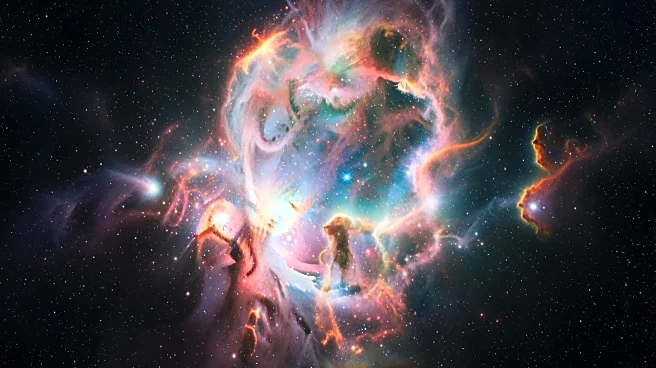
The James Webb Space Telescope has released new images of the Exposed Cranium Nebula, also known as Nebula PMR 1. These images reveal distinct regions within the nebula that represent different phases of its evolution. The outer shell, primarily composed
of hydrogen, was expelled first, while the inner cloud contains a mix of gases and more complex structures. A dark line running vertically through the nebula, giving it a cranial appearance, may result from an outburst or outflow from the central star, typically occurring as twin jets burst out in opposite directions. The images were captured using Webb's Near-Infrared Camera (NIRCam) and Mid-Infrared Instrument (MIRI).
Why It's Important?
The images from the James Webb Space Telescope provide valuable insights into the life cycle of stars and the formation of nebulae. Understanding these processes is crucial for astronomers as they seek to unravel the mysteries of the universe. The detailed observations of the Exposed Cranium Nebula contribute to our knowledge of stellar evolution and the complex interactions within nebulae. This information can enhance our understanding of the cosmos and inform future astronomical research and exploration.