





What's Happening?
China has released its most detailed footage to date of the Gongji-11 (GJ-11) stealth strike drone, also known as "Strike-11." State media outlet CCTV aired segments showcasing multi-angle, close-up views of the drone both on the ground and in flight,
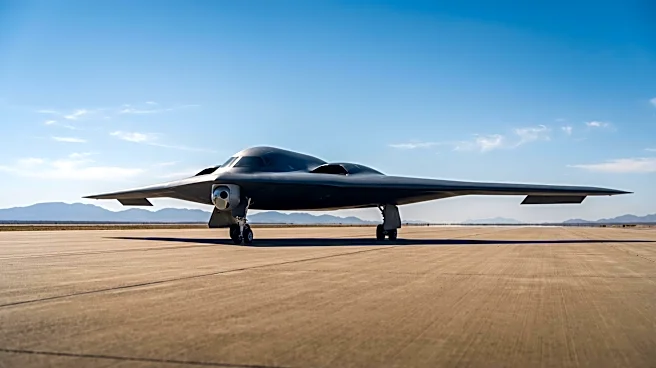
revealing its weapon bays, nose-mounted sensor, and landing gear. The GJ-11, first unveiled in 2019 and indicated to be in service by 2025, features a tailless, flying-wing design similar to the B-2 Spirit bomber, with a 47-foot wingspan and internal engines for stealth. Its nose-mounted electro-optical and infrared sensor resembles those on fifth-generation fighter jets like the F-35. State media reports indicate the GJ-11 is designed for deep-strike missions against fortified ground targets such as command posts and air defenses, carrying multiple guided bombs and precision-strike munitions. The drone is also intended to operate as a "loyal wingman" alongside crewed aircraft like the J-20 stealth fighter, with the fighter jet clearing the skies while directing the GJ-11 to hit high-value targets. Footage also showed ground crews controlling the GJ-11 from a mobile command trailer, and a separate report highlighted female drone operators conducting a live-fire strike test.
Why It's Important?
The detailed unveiling of the GJ-11 signifies a significant advancement in China's military aviation capabilities, particularly in unmanned aerial systems. This development is important for the U.S. as it highlights China's progress in a class of stealth strike drones that the U.S. largely shelved a decade ago, shifting focus to refueler aircraft and attritable Collaborative Combat Aircraft (CCA). The GJ-11's capabilities for deep strikes and its potential role as a loyal wingman could alter strategic calculations in potential conflict scenarios, particularly in the Indo-Pacific. For U.S. defense planners, this means reassessing potential threats and developing countermeasures. The drone's stealth features and precision-strike capabilities could pose challenges to existing air defense systems. Furthermore, China's emphasis on human operators, even for advanced drones, provides insight into its doctrine for integrating unmanned systems into its air force, contrasting with the U.S. focus on autonomous capabilities for future drone fleets. This technological leap could influence military spending and research priorities in the U.S. and among its allies.
What's Next?
Following this detailed reveal, it is likely that defense analysts globally will intensify their study of the GJ-11's capabilities and potential operational doctrines. The U.S. military and its allies may accelerate their own research and development into advanced unmanned systems and counter-drone technologies. There could be increased intelligence gathering efforts to ascertain the full extent of the GJ-11's autonomous capabilities, operational range, and weapon payloads. China is expected to continue integrating the GJ-11 into its People's Liberation Army Air Force (PLAAF) and potentially showcase its capabilities in future military exercises. The development of a naval version, the GJ-21, which reportedly took off from an amphibious assault ship, suggests future naval applications and further expansion of China's drone fleet. This could lead to a renewed debate within the Pentagon regarding the necessity of high-end, high-cost stealth strike drones versus the current focus on mass-produced, attritable CCAs, potentially influencing future defense procurement decisions and strategic investments.
Beyond the Headlines
The emergence of the GJ-11 highlights a broader strategic divergence in military technology development between China and the U.S. While the U.S. has shifted towards more cost-effective, attritable drones for collaborative combat, China appears to be investing heavily in high-end, stealthy strike platforms. This divergence could lead to different operational philosophies and battlefield dynamics in future conflicts. Ethically, the increasing sophistication of stealth strike drones raises questions about accountability in autonomous warfare, even with human oversight, and the potential for escalation. The technological race in unmanned systems also has significant economic implications, driving innovation and competition in the defense industry globally. Furthermore, the GJ-11's design, reminiscent of the B-2 bomber, underscores the ongoing influence of established stealth aircraft principles while adapting them for unmanned operations. This development could also spur other nations to invest more heavily in their own stealth drone programs, potentially leading to a new arms race in unmanned aerial vehicles and reshaping global air power dynamics.