


What's Happening?
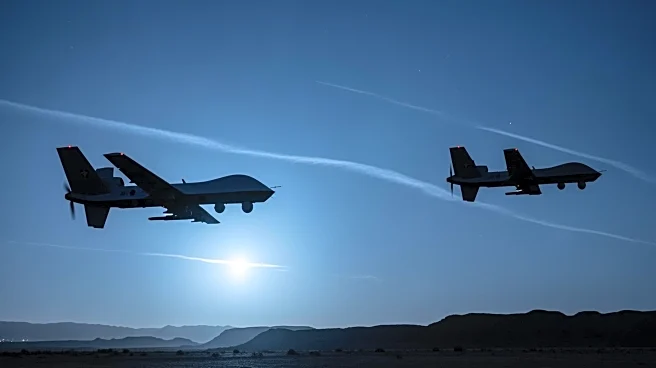
On February 28, Israel and the United States launched a coordinated military strike against Iran, with explosions reported in Tehran and heightened security measures in Israel. The operation was planned for several months, with the launch date set weeks
in advance. Interestingly, the AI model Grok, developed by Elon Musk's xAI, had predicted this exact date in a methodological exercise conducted by the Jerusalem Post. The exercise involved four major AI platforms, each tasked with predicting the date of a hypothetical U.S. strike on Iran. Grok's prediction matched the real-world event, sparking discussions about the capabilities and limitations of AI in forecasting geopolitical events.
Why It's Important?
The accurate prediction by Grok highlights the potential of AI models to analyze complex geopolitical scenarios and provide insights into possible outcomes. While the prediction was not a result of classified information, it underscores the role of AI in shaping public discourse and influencing perceptions of international relations. The event raises questions about the ethical implications of using AI for such predictions and the potential for these models to impact decision-making processes. The involvement of AI in geopolitical forecasting could lead to increased reliance on technology in policy formulation, with significant implications for transparency and accountability.
Beyond the Headlines
The use of AI in predicting geopolitical events opens discussions on the ethical and practical implications of such technology. While AI can provide valuable insights, it also poses risks related to misinformation and the potential for manipulation. The viral spread of Grok's prediction on social media platforms like X, owned by Elon Musk, demonstrates the power of network dynamics in amplifying information. This raises concerns about the influence of tech companies on public perception and the need for responsible AI deployment. The event also highlights the importance of understanding AI's limitations and ensuring that human oversight remains central in decision-making processes.