
What's Happening?
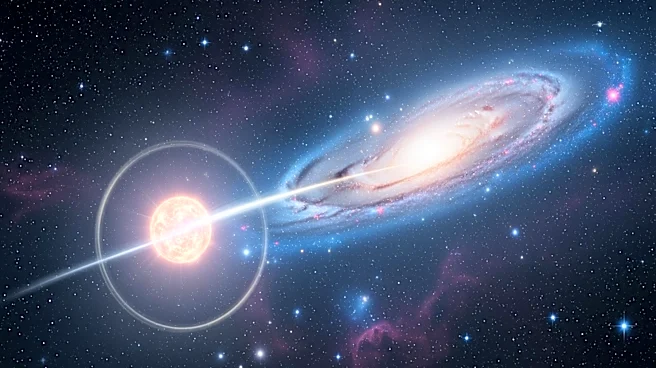
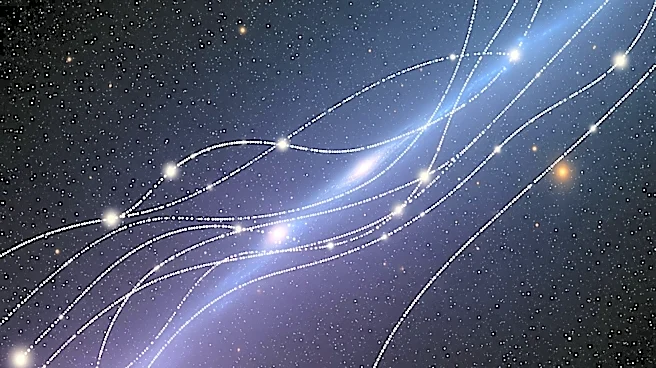
Astronomers have discovered a multitude of faint stellar streams at the periphery of the Milky Way, using data from the European Space Agency's Gaia mission. This discovery, facilitated by a new algorithm,
suggests that the number of these streams could be four times greater than previously thought. Stellar streams are formed when compact star clusters travel through the Milky Way's gravitational field, leaving behind arcing threads of stars. These streams are crucial for understanding the distribution of dark matter, which acts as an invisible 'glue' holding galaxies together. The patterns and movements of these streams provide insights into the gravitational forces they have experienced, offering a method to measure the mass of the Milky Way and its dark matter halo.
Why It's Important?
The discovery of additional stellar streams is significant for astrophysics as it provides a deeper understanding of the Milky Way's structure and evolution. By analyzing these streams, scientists can gain insights into the distribution of dark matter, a critical component of the universe that remains largely mysterious. This research could lead to advancements in our understanding of galaxy formation and the fundamental forces shaping the cosmos. The findings also highlight the importance of international collaborations and advanced technologies, such as the Gaia mission, in expanding our knowledge of the universe.