
What's Happening?
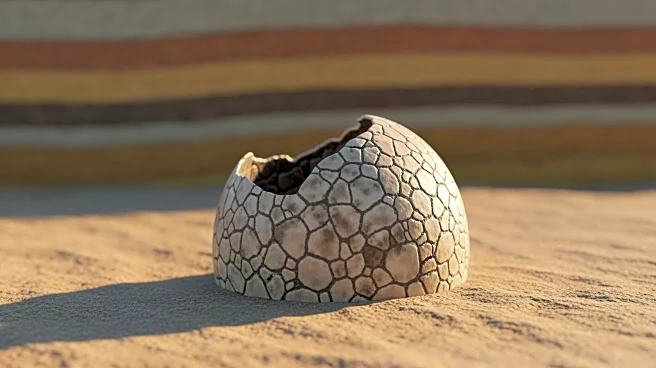
Researchers have developed a new method for dating dinosaur eggshells, providing a more accurate way to determine the age of fossils. This technique, detailed in Communications Earth & Environment, uses
uranium-lead dating to measure the ratio of uranium to lead in eggshells, which acts as a geological clock. The method was tested on eggshells from Utah and Mongolia, yielding precise age estimates that align closely with known volcanic ash dates. This breakthrough addresses a major challenge in paleontology, where traditional dating methods often rely on surrounding volcanic materials that are not always present.
Why It's Important?
The ability to directly date dinosaur eggshells represents a significant advancement in paleontology, allowing scientists to establish more precise timelines for fossil sites. This method can help resolve long-standing debates about the age of certain fossils and the ecosystems they belonged to. By providing accurate age estimates, researchers can better understand the evolutionary history of species and the environmental changes they experienced. This technique could also be applied to other fossilized eggs, potentially offering new insights into the history of birds and reptiles.
What's Next?
The new dating method will likely be applied to other fossil sites to test its effectiveness and expand its use. Researchers will continue to refine the technique, ensuring its accuracy and reliability across different geological contexts. The method's success depends on the preservation of the eggshell's original calcite structure, so ongoing research will focus on identifying suitable samples. As the technique gains acceptance, it could become a standard tool in paleontology, providing a clearer picture of Earth's ancient past.