



What's Happening?
An 11-year-old girl named Ruby Reynolds discovered a significant fossil on the southwest coast of England, leading scientists to identify a new prehistoric marine species. The fossil, a lower jawbone over two meters long, belongs to a newly named giant
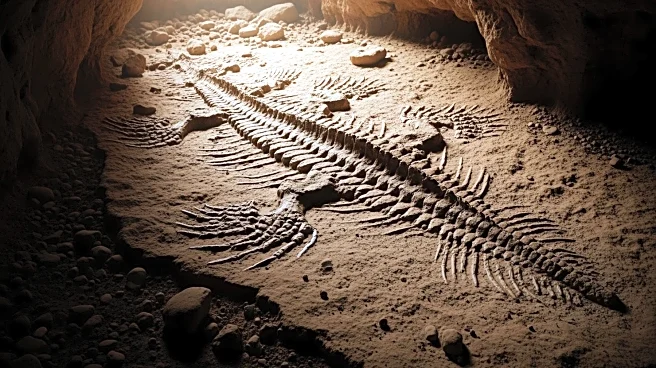
ichthyosaur species, Ichthyotitan severnensis. This discovery was made during a routine fossil-hunting trip to Blue Anchor in Somerset. The fossil matched a previously unearthed jaw fragment found in 2016 at Lilstock, about 10 kilometers away. Both fossils originate from the Westbury Mudstone Formation, dating to the end of the Triassic period, around 202 million years ago. Researchers from the University of Bristol and University of Manchester analyzed the fossils, confirming their shared characteristics. The findings were published in a peer-reviewed study in PLOS ONE, suggesting the marine reptile may have reached a total body length of approximately 25 meters, comparable to today's blue whales.
Why It's Important?
The discovery of Ichthyotitan severnensis is significant as it may represent the largest marine reptile ever recorded, challenging previous understandings of prehistoric marine life. This finding provides new insights into the size and diversity of ichthyosaurs, which were dominant marine predators during the Triassic period. The fossil's size and unique features suggest that some ichthyosaurs attained extreme sizes under favorable environmental conditions. This discovery also highlights the potential for significant paleontological finds in the UK, contributing to the understanding of marine life evolution and the ecological roles of large marine reptiles before the Triassic-Jurassic extinction event.
What's Next?
Further research and exploration in the Westbury Mudstone Formation and surrounding areas may uncover additional fossils, providing more comprehensive insights into the life and environment of Ichthyotitan severnensis. Scientists may focus on finding more complete skeletons to confirm size estimates and understand the species' biology and ecology better. The discovery may also prompt a reevaluation of other ichthyosaur fossils, potentially leading to the identification of more new species. Continued study of the Triassic-Jurassic transition period could reveal more about the extinction events and the subsequent evolution of marine life.
Beyond the Headlines
The discovery of Ichthyotitan severnensis raises questions about the adaptability and evolution of marine reptiles in response to environmental changes. The fossil's context, just before the Triassic-Jurassic extinction event, suggests that these large predators were among the last of their kind before significant ecological shifts. This finding may influence how scientists understand the impact of mass extinctions on marine biodiversity and the evolutionary pathways of surviving species. Additionally, the role of amateur fossil hunters in significant scientific discoveries is highlighted, emphasizing the importance of public engagement in paleontology.