
What's Happening?
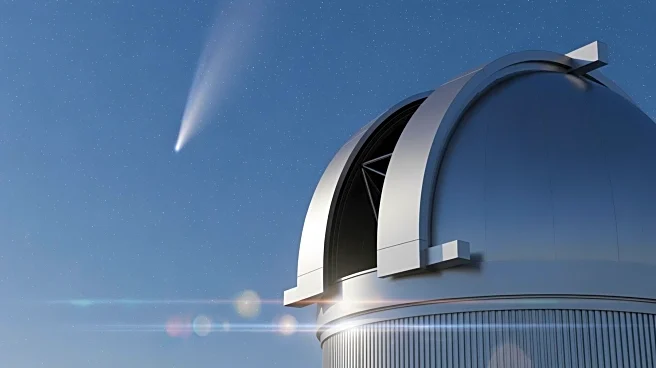
The ATLAS network, or Asteroid Terrestrial-impact Last Alert System, has played a crucial role in the discovery of the interstellar comet 3I/ATLAS. This network, consisting of wide-field telescopes, is designed
to detect near-Earth objects by repeatedly imaging large areas of the sky. On July 1, 2025, Larry Denneau, a senior software engineer and astronomer at the University of Hawaii's Institute for Astronomy, identified 3I/ATLAS as a potential new object. Initially appearing as a typical near-Earth object, further observations revealed its interstellar nature, making it only the third-known interstellar visitor observed in our solar system. The ATLAS system uses custom software to process images and identify moving objects, which are then verified by human reviewers.
Why It's Important?
The discovery of 3I/ATLAS underscores the importance of systems like ATLAS in planetary defense and astronomical research. By identifying interstellar objects, scientists gain insights into materials formed around other stars, which can enhance our understanding of the universe. The ability to detect such objects also highlights the technological advancements in automated sky surveys, which are crucial for early warning systems against potential asteroid impacts. The discovery of 3I/ATLAS not only contributes to scientific knowledge but also demonstrates the effectiveness of combining software and human expertise in astronomical observations.
What's Next?
Following the discovery of 3I/ATLAS, astronomers will continue to monitor its trajectory and gather data to better understand its composition and origin. The Minor Planets Center and the Jet Propulsion Laboratory are involved in fitting observations to compute its orbit. This ongoing research may lead to further discoveries about interstellar objects and their interactions with our solar system. Additionally, the success of the ATLAS network may encourage the development of similar systems to enhance global planetary defense capabilities.