

What's Happening?
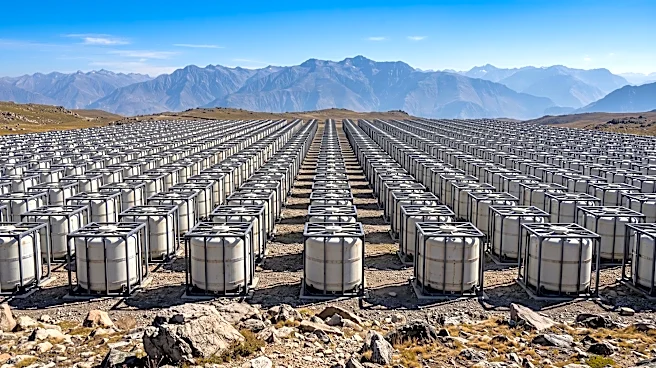
Scientists have conducted a precision measurement to calibrate the absolute energy response of the Water Cherenkov Detector Array (WCDA) at the National Facility for Large High Altitude Air Shower Observatory (LHAASO). This calibration utilized 3.4 years
of data from the Moon's shadow, a phenomenon where cosmic rays are partially blocked by the Moon, creating a deficit in their flux. The Moon's shadow is slightly displaced westward due to the Earth's magnetic field, and this deflection is energy-dependent, allowing for energy scale calibration. By combining this physical measurement with four cosmic-ray composition models, researchers calibrated the detector's energy response in the 4-37 TeV range. The study quantified the fractional deviation between calibrated and simulated energy scales, yielding a 95% confidence interval of -9% to +0.2% for the systematic energy scale deviation. This geomagnetic calibration provides a data-driven validation of the simulated WCDA energy response, refining the overall energy scale and bounding systematic uncertainties.
Why It's Important?
This research is significant for the field of cosmic ray physics, particularly for ground-based detectors. Accurate energy calibration is essential for precise measurements of primary cosmic ray particles, which are crucial for understanding their origins, acceleration mechanisms, and composition. The LHAASO observatory, located at a high altitude, plays a vital role in this research by observing cascades of secondary cosmic ray particles. The refined energy scale provided by this calibration enhances the reliability of data collected by LHAASO-WCDA, which contributes to a deeper understanding of high-energy astrophysical phenomena. For the broader scientific community, this improved calibration technique strengthens the foundation for future cosmic ray studies, potentially leading to new discoveries about the universe's most energetic particles. The ability to validate simulated energy responses with real-world data also improves the accuracy of theoretical models in astrophysics.
What's Next?
The successful calibration of the LHAASO-WCDA energy scale using the cosmic ray Moon shadow data will likely lead to more precise analyses of cosmic ray and high-energy gamma-ray sources. This enhanced accuracy will enable scientists to address a wider spectrum of challenges in astrophysical research with greater confidence. Future studies may leverage this refined calibration to investigate subtle features in cosmic ray spectra, search for new sources of high-energy particles, and explore the interactions of cosmic rays with interstellar and intergalactic magnetic fields. The methodology developed in this work could also be applied to other ground-based cosmic ray detectors, improving their energy calibration and overall scientific output. Continued monitoring of the Moon's shadow and further data collection will allow for even more robust calibrations and potentially reveal new insights into the behavior of cosmic rays and the Earth's geomagnetic field.
Beyond the Headlines
The technique of using the Moon's shadow for cosmic ray detector calibration highlights an ingenious application of natural phenomena to advance scientific understanding. This method, which relies on the Earth's magnetic field deflecting charged cosmic ray particles, provides a unique and independent way to verify detector performance. Beyond its direct application in astrophysics, this research contributes to the broader understanding of fundamental physics, including particle interactions and magnetic field effects in space. The continuous operation and maintenance of facilities like LHAASO, often in challenging high-altitude environments, underscore the dedication required for cutting-edge scientific research. The collaborative nature of such projects, involving numerous scientists and institutions, also exemplifies how international cooperation is essential for tackling complex scientific questions that transcend national boundaries, ultimately benefiting global scientific knowledge.