

What's Happening?
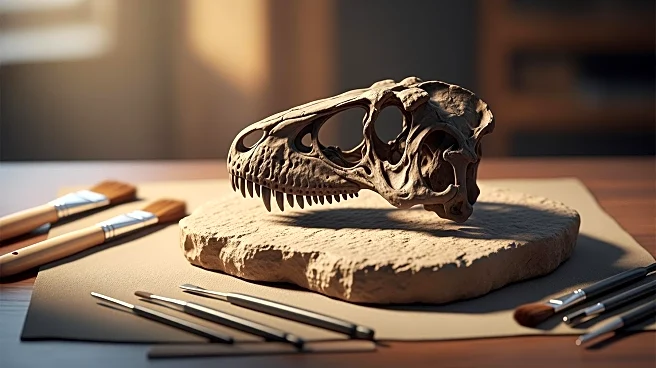
Researchers from The University of Texas at Austin, in collaboration with the Korean Dinosaur Research Center, have discovered a new species of baby dinosaur on Korea's Aphae Island. The dinosaur, named Doolysaurus huhmini, is the first new dinosaur species discovered in Korea in 15
years and the first to include portions of its skull. The name honors Dooly, a beloved cartoon character in Korea, and Min Huh, a prominent Korean paleontologist. The fossil was revealed through a micro-CT scan at the University of Texas High-Resolution X-ray Computed Tomography facility, which uncovered the skull and other bones. The dinosaur is estimated to have lived about 113–94 million years ago during the mid-Cretaceous period and is classified as a thescelosaurid, a type of bipedal dinosaur.
Why It's Important?
The discovery of Doolysaurus huhmini is significant as it adds to the understanding of dinosaur diversity in East Asia, particularly in Korea, which is known for trace fossils but lacks actual dinosaur bones. This finding could lead to further discoveries in the region, potentially uncovering more about the types of dinosaurs that lived there. The use of micro-CT technology in this research highlights its importance in paleontology, allowing scientists to examine fossils encased in hard rock without damaging them. This technological advancement could revolutionize the study of delicate fossils, providing new insights into the anatomy and lifestyle of ancient species.
What's Next?
Researchers plan to continue exploring Aphae Island and other areas in Korea for more fossils, using micro-CT technology to uncover hidden specimens. The skills learned by Korean researchers at the Jackson School will be applied to study additional fossils in Korea, potentially leading to more discoveries. The ongoing collaboration between international researchers could enhance the understanding of dinosaur evolution and diversity in the region. Future studies may focus on the ecological role of Doolysaurus and its interactions with other species during the Cretaceous period.