






What's Happening?
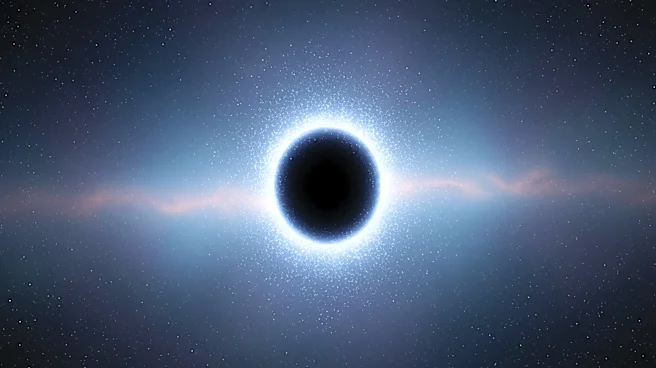
A recent study proposes a solution to the 'black hole information paradox,' suggesting that black holes may not completely evaporate but instead leave behind stable remnants. This theory, based on the Einstein-Cartan theory in a 7-dimensional space, posits
that a repulsive force at extreme densities prevents the complete evaporation of black holes, leaving behind remnants with a mass of approximately 9 x 10^-41 kg. These remnants could potentially contribute to dark matter. The study also links this phenomenon to the Higgs field, suggesting a geometric explanation for the mass of fundamental particles.
Why It's Important?
The findings challenge the long-standing belief that black holes evaporate completely, potentially altering our understanding of quantum mechanics and the universe's structure. If proven, the existence of stable black hole remnants could provide insights into dark matter, a major component of the universe's mass. Additionally, the study's connection to the Higgs field could offer a new perspective on particle physics, particularly regarding the mass of elementary particles. This research could lead to a paradigm shift in both astrophysics and quantum mechanics.
What's Next?
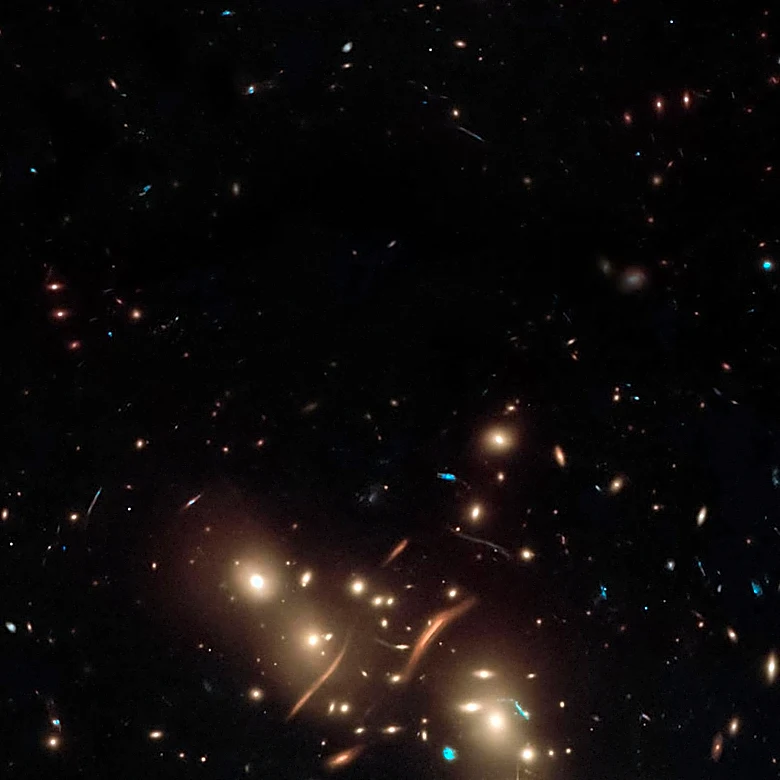
Future research will focus on detecting the gravitational signatures of these 'Planckian relics' to provide empirical evidence for the theory. The study's predictions are testable through observations of the universe's depths, rather than laboratory experiments. If confirmed, this could open new avenues for understanding the early universe and the fundamental forces shaping it. The implications for dark matter research and particle physics could be profound, potentially leading to new discoveries about the universe's composition and the laws governing it.