







What's Happening?
Researchers at the Korea Advanced Institute of Science and Technology (KAIST) in South Korea have developed a new technology aimed at producing smaller and lighter electric vehicle (EV) batteries with longer driving ranges. This breakthrough addresses
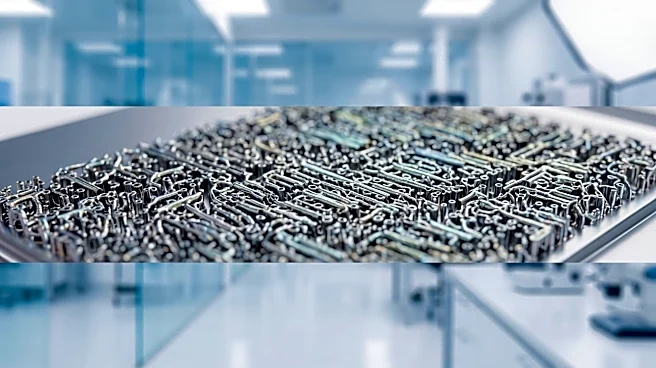
a significant challenge in anode-free batteries, which typically have a limited lifespan due to the formation of sharp lithium structures, known as dendrites, during charging. The KAIST team, led by Professors Jinwoo Lee and Hee-Tae Jung, adapted precision manufacturing techniques from the semiconductor industry. They created a microscopic tubular pattern on copper foil, which allows lithium to accumulate more evenly. This structured surface, combined with an ultrathin MXene coating, promotes the formation of a stable protective layer, preventing the growth of damaging lithium spikes and extending the battery's operational life. This method avoids adding substantial material, thus preserving the size and weight advantages of anode-free battery technology.
Why It's Important?
This development holds significant importance for the electric vehicle industry and the broader energy storage sector. Anode-free batteries offer the potential for higher energy density, meaning more power can be stored in a smaller and lighter package. This directly translates to extended driving ranges for EVs without increasing the vehicle's weight or requiring larger battery packs, which has been a major hurdle in EV adoption. By improving the lifespan and stability of these batteries, the KAIST research could accelerate their commercial viability. A more efficient and durable battery technology could reduce manufacturing costs, enhance consumer confidence in EVs, and contribute to global decarbonization efforts by making electric transportation more accessible and practical. The ability to store more energy in less space also has implications for portable electronics and renewable energy systems, where compact and efficient energy storage is crucial.
What's Next?
The immediate next steps involve further research and development to scale this technology for industrial production. While the KAIST team has demonstrated a significant improvement in battery lifespan, the transition from laboratory success to mass manufacturing presents its own set of challenges, particularly concerning cost and large-scale fabrication. The researchers anticipate that these findings will help accelerate the commercial development of high-energy anode-free batteries. Collaboration with battery manufacturers and automotive companies will be crucial to integrate this technology into existing production lines and conduct extensive real-world testing. If successful, this could lead to a new generation of EV batteries that are not only more powerful and longer-lasting but also more cost-effective to produce, potentially transforming the electric vehicle market within the next decade.
Beyond the Headlines
The deeper implications of this research extend beyond just electric vehicles. The adaptation of semiconductor manufacturing techniques for battery production highlights a growing trend of interdisciplinary innovation, where advancements in one field can revolutionize another. This approach could pave the way for other novel battery designs that leverage precision engineering to overcome material limitations. Furthermore, the focus on preventing dendrite formation and stabilizing the protective layer addresses fundamental challenges in battery chemistry, which could benefit various battery types, including solid-state batteries. The potential for smaller, lighter, and more durable batteries could also impact the design and functionality of portable electronic devices, drones, and even grid-scale energy storage solutions, fostering a more sustainable and energy-efficient future. This research underscores the continuous drive for innovation in energy storage as a cornerstone of modern technological progress.