
What's Happening?
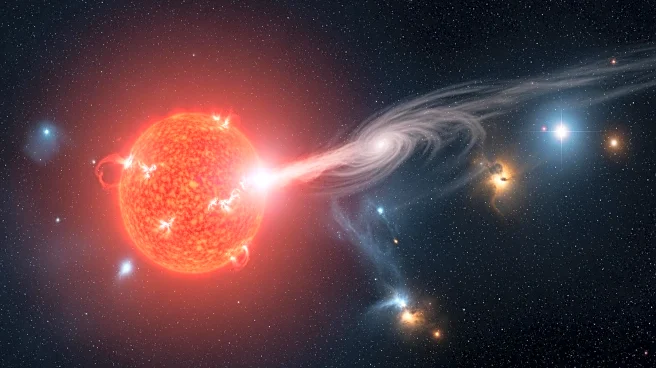
NASA's Hubble Space Telescope, along with ground-based observatories, has detected the influence of a companion star, Siwarha, on the red supergiant Betelgeuse. This discovery, led by scientists at the Center
for Astrophysics | Harvard & Smithsonian, reveals a trail of dense gas in Betelgeuse's atmosphere, explaining its unusual brightness changes. The findings were presented at the American Astronomical Society meeting and are set for publication in The Astrophysical Journal. The companion star's wake was tracked by observing changes in Betelgeuse's light over eight years, confirming its impact on the star's behavior. Betelgeuse, located 650 light-years away in Orion, is a massive star nearing the end of its life, making it a key subject for studying stellar evolution.
Why It's Important?
The detection of Siwarha's wake provides crucial insights into the behavior and evolution of massive stars like Betelgeuse. Understanding the interactions between Betelgeuse and its companion star helps explain the star's brightness variations and atmospheric changes. This discovery resolves a long-standing mystery about Betelgeuse, offering a clearer picture of how such stars age, lose mass, and eventually explode as supernovae. The findings also have broader implications for studying other giant stars, as they provide a model for understanding similar phenomena in different stellar systems. This research enhances our knowledge of stellar life cycles and the processes leading to supernovae.
What's Next?
With Betelgeuse currently eclipsing its companion, astronomers plan to conduct new observations when the companion re-emerges in 2027. These future studies will aim to further understand the interactions between Betelgeuse and Siwarha, providing more data on the dynamics of massive stars. The research may also help explain similar mysteries in other giant stars, contributing to a more comprehensive understanding of stellar evolution. Continued observations using Hubble and other telescopes will likely lead to additional discoveries about the life cycles of massive stars and their eventual fate as supernovae.