
What's Happening?
The Democratic Republic of Congo (DRC) has initiated a $100 million plan, supported by the U.S. and UAE, to establish a paramilitary force aimed at securing its mining sector. The General Inspectorate
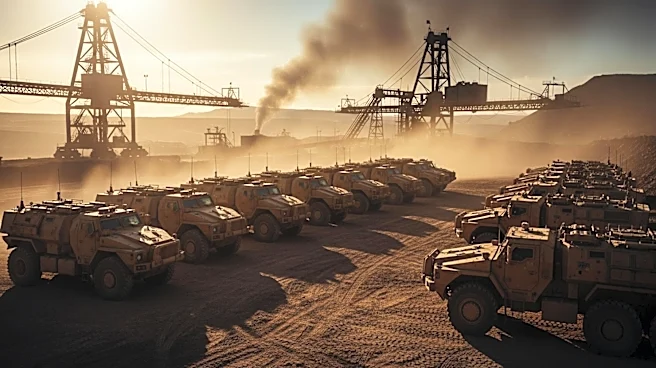
of Mines (IGM) announced the creation of a 'mining guard,' a paramilitary unit designed to protect the mineral exploitation chain across the country. Initially, 2,500 to 3,000 recruits will undergo six months of training, with the force expected to be operational by December 2026. The unit's responsibilities include securing mine sites and escorting mineral shipments. The DRC, a major producer of cobalt and other minerals, faces security challenges in its eastern regions, exacerbated by the presence of the Rwanda-backed M23 group.
Why It's Important?
This development is significant as it addresses the security issues in the DRC's mineral-rich regions, which are crucial for global supply chains, particularly for cobalt used in electric vehicle batteries. The initiative reflects efforts to improve governance and transparency in the mining sector, which is vital for attracting foreign investment. The U.S. involvement indicates a strategic move to counter China's influence in the DRC's mineral sector. The establishment of this force could stabilize the region, potentially benefiting international companies and ensuring a steady supply of critical minerals.
What's Next?
The paramilitary force is expected to expand to over 20,000 personnel by 2028, covering all 22 mining provinces. Ongoing negotiations between the DRC government and M23 rebels could influence the security landscape. The DRC and Rwanda's agreement, facilitated by U.S. talks, aims to resolve conflicts and ensure access to strategic minerals for U.S. companies. The success of this initiative could lead to increased foreign investment and a more stable mining sector, impacting global supply chains.
Beyond the Headlines
The creation of this paramilitary force raises questions about the militarization of resource-rich areas and its implications for local communities. While it aims to secure the mining sector, there are concerns about potential human rights abuses and the impact on local populations. The initiative also highlights the geopolitical competition for resources, with the U.S. seeking to reduce China's dominance in the DRC. The long-term success of this force will depend on its ability to operate transparently and respect local communities' rights.