
What's Happening?
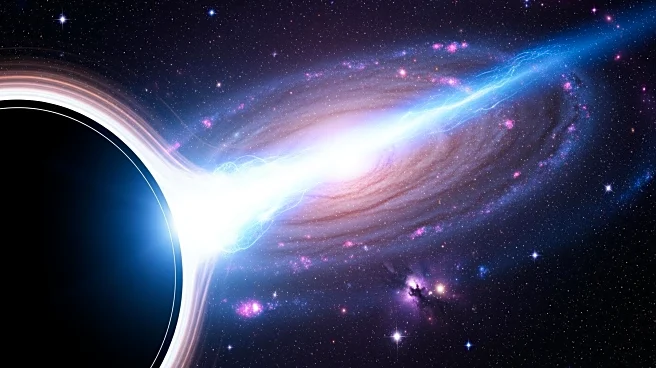
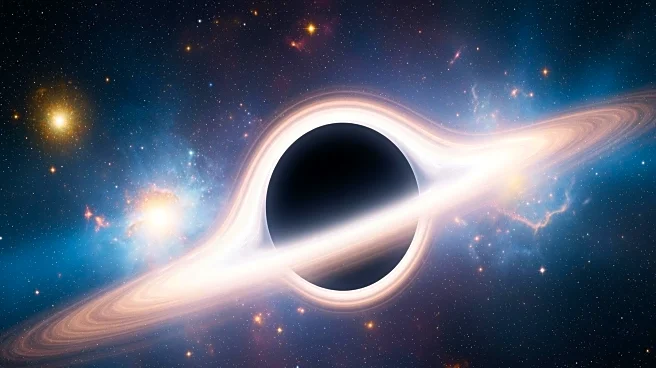
The James Webb Space Telescope (JWST) has uncovered a supermassive black hole in a galaxy from the early universe, challenging existing theories about black hole formation. The galaxy, named Virgil, was
observed as it appeared 800 million years after the Big Bang. The discovery, led by astronomers from the University of Arizona, reveals that Virgil harbors a supermassive black hole accreting material at an extraordinary rate, obscured by dust. This finding suggests that black holes may have formed before galaxies, contradicting previous beliefs that galaxies nurtured black holes over time.
Why It's Important?
This discovery has significant implications for our understanding of cosmic history and the formation of supermassive black holes. It challenges the prevailing theory that galaxies and black holes grew together, suggesting instead that black holes may have formed independently and earlier. This could lead to a reevaluation of models regarding the early universe and the role of black holes in cosmic evolution. The findings also highlight the capabilities of the JWST in revealing hidden cosmic phenomena, potentially leading to further breakthroughs in astronomy.