



What's Happening?
Astronomers utilizing NASA’s Chandra X-ray Observatory have identified the cause behind a unique radio wave formation dubbed the 'Treble Clef,' due to its resemblance to the musical symbol. The research, led by Andrea Botteon of the National Institute
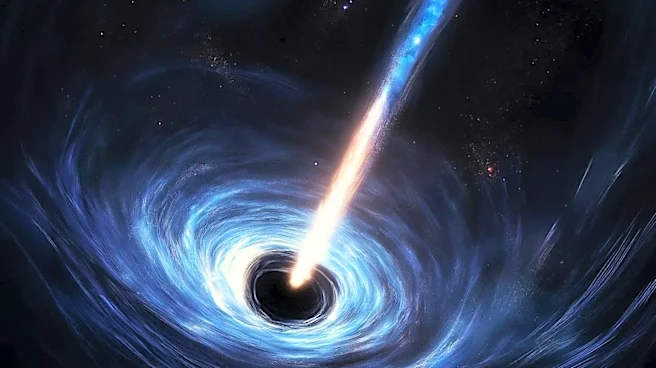
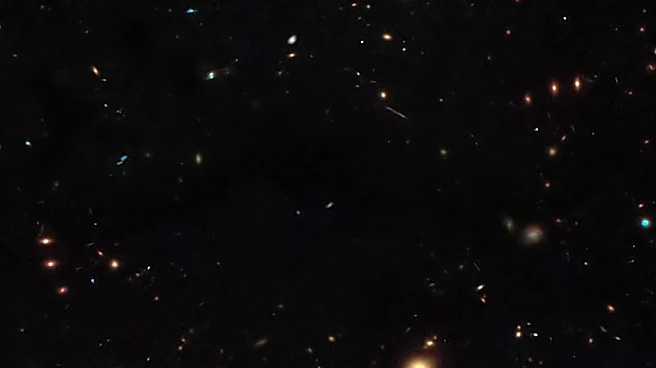
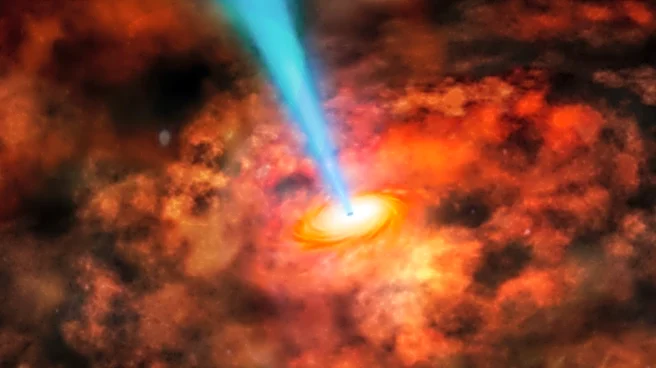
for Astrophysics (INAF) in Italy, suggests that the Treble Clef originated from a two-stage process. Initially, an outburst from a supermassive black hole at the center of a galaxy cluster propelled charged particles and magnetic fields at near light speed, creating bright radio waves that later faded. Subsequently, a collision between two galaxy clusters compressed and re-energized these clouds, causing them to brighten again in radio waves. The formation is located almost directly behind the Milky Way's plane, making it challenging to observe, but X-ray telescopes like Chandra and the German eROSITA were able to penetrate the intervening material. These observations revealed diffuse, hot gas, indicating the presence of a galaxy cluster that is, in fact, two merging clusters. The study was published in the Astronomy & Astrophysics journal.
Why It's Important?
This discovery significantly advances our understanding of galaxy cluster dynamics and the impact of supermassive black holes on their environments. Galaxy clusters are among the largest structures in the universe, and their collisions are powerful events that can trigger complex phenomena. The 'Treble Clef' provides a unique case study for how these cosmic events can re-energize ancient outflows from black holes, offering insights into the life cycles of galaxies and the distribution of matter in the universe. The use of advanced X-ray and radio telescopes to peer through dense galactic material demonstrates the critical role of multi-wavelength astronomy in unraveling cosmic mysteries. Understanding these processes helps refine cosmological models and provides a clearer picture of the universe's evolution, impacting the broader scientific community's efforts to map and comprehend the cosmos.
What's Next?
The researchers suggest that the direct collision between the two galaxy clusters likely occurred a few hundred million years ago, and they are currently moving apart. Future observations will likely focus on further analyzing the properties of the re-energized clouds and the surrounding environment to gain a more detailed understanding of the collision's aftermath. Astronomers may also seek similar 'relic' structures in other merging galaxy clusters to determine if this two-stage formation process is a common occurrence. Continued advancements in telescope technology and observational techniques will be crucial for detecting and studying such complex phenomena, potentially leading to new insights into the interplay between supermassive black holes, galaxy evolution, and the large-scale structure of the universe.
Beyond the Headlines
The 'Treble Clef' phenomenon highlights the concept of pareidolia in scientific observation, where familiar patterns are perceived in random data. While the resemblance to a musical symbol is coincidental, it underscores the human tendency to find patterns, even in the vastness of space. Scientifically, this discovery emphasizes the long-term effects of energetic events in the universe. The initial outburst from the black hole and the subsequent galaxy cluster collision demonstrate that cosmic events can have delayed and cascading impacts, shaping the universe over immense timescales. This intricate interplay of forces and matter, observed across billions of light-years, offers a profound perspective on the dynamic and ever-evolving nature of the cosmos, pushing the boundaries of our understanding of astrophysical processes.